-
Cobalt
Outlook for key energy transition minerals This report provides an outlook for demand and supply for key energy minerals including copper, lithium, nickel, cobalt, graphite and rare earth elements. Demand projections encompass both key energy technologies and other uses under different IEA Scenarios. Supply projections are based on a detailed review of all announced projects. They show how today's geographical concentration evolves over time, for both mining and refining and how expected supply compares with primary supply requirements.
-
World Energy Outlook 2025
The IEA’s flagship World Energy Outlook (WEO) is the most authoritative source of global energy analysis and projections. Updated annually to reflect the latest energy data, technology and market trends, and government policies, it explores a range of possible energy futures and their implications for energy security, access and emissions. The WEO covers the whole energy system, using a scenario-based approach to highlight the central choices, consequences and contingencies that lie ahead. It includes exploratory scenarios that flow from different assumptions about existing policies, as well as normative pathways that achieve energy and emissions goals in full. The multi…

-
Global battery markets are growing strongly – and so are the supply risks
…came from portable electronics; by 2025, this share had fallen to below 5%. Falling prices have been instrumental to this expansion. In 2025, average battery prices declined by 8%, supported by advances in manufacturing, improvements in battery chemistries and intensifying global market competition. Battery energy storage systems (BESS) saw the sharpest price declines, with average global prices in 2025 falling to one-third of levels seen in 2020.At the same time, regional price disparities have widened. In 2025, battery pack prices in China were 30% lower than in the United States, and 35% lower than in Europe. Record low lithium…
-
Energy Efficiency Policy Toolkit Industry
Introduction Industry accounts for 37% of final energy consumption globally. Doubling global energy intensity improvement by 2030 would require the decoupling of production from energy demand and raising the share of electricity in energy use from 23% in 2022 to 30% in 2030. An integrated policy approach combining regulation, information and incentives is the most effective way to achieve this goal.Regulations such as minimum energy performance standards for motors increase the efficiency of industrial processes by requiring new motors to use less energy per unit of output. This also drives the innovation of more efficient technologies. The alignment of international…

-
Energy System Resilience
Lessons learned from Ukraine Ensuring energy security encompasses both long-term and short-term dimensions. The long-term dimension involves securing sufficient infrastructure investment and diverse supply sources. The short-term dimension – resilience – focuses on systems’ ability to cope with events exceeding standard planning conditions. Since Russia’s full-scale invasion in 2022, Ukraine has worked to protect its energy sector and to increase its ability to withstand and rapidly recover from Russia’s attacks on its energy infrastructure. The report explores the lessons that Ukraine has been learning as it works to bolster system resilience and identifies measures that…

-
Ramping up Heat Pumps in Moldova: A Roadmap Status and key indicators
…funds, state budgets and energy efficiency obligations.The Ministry of Environment has a broad ecological remit to ensure energy policies align with sustainability goals, promote efficient energy consumption and support renewables. Moldova’s regulatory authority in the energy sector is the National Agency for Energy Regulation (ANRE). It oversees market regulation and approves prices and tariffs for electricity, natural gas and district heating, as well as water and sewage.The National Bureau of Statistics (NBS) is the country’s main statistical body. It defines statistical methodologies, conducts national surveys and collects and processes data for Moldova’s energy balance, which…

-
Policy options to accelerate distributed solar PV in Ukraine Policy options and implications
Overview of policy instruments for distributed solar PV deployment Globally, government policies and incentives have been the main driver for distributed PV deployment. These instruments can be differentiated between 1) policies targeting investment costs and 2) policies focusing on consumption and the sale of electricity.Policies targeting investment costs usually take the form of direct financial incentives that aim to reduce initial investment costs and make distributed PV systems more affordable for consumers. They include:Grants and rebates: a fixed subsidy, usually with a one-time payment.Tax credits: amounts taxpayers can subtract from taxes, usually based on a percentage…

-
Austria 2026 Executive summary
…electricity generation), including 5.6 gigawatts (GW) of pumped hydro storage and a nationwide smart meter roll-out. Austria has the highest share of renewable energy in electricity consumption in the European Union and is the first European country to develop a pioneering approach to integrated energy system planning. However, the gap between ambition and delivery is widening. While economy-wide greenhouse gas (GHG) emissions have fallen by 16% since 1990, emissions including land use, land-use change and forestry (LULUCF) have increased by 13%. In other words, Austria’s forests are losing their ability to absorb carbon, emphasising the urgent…

-
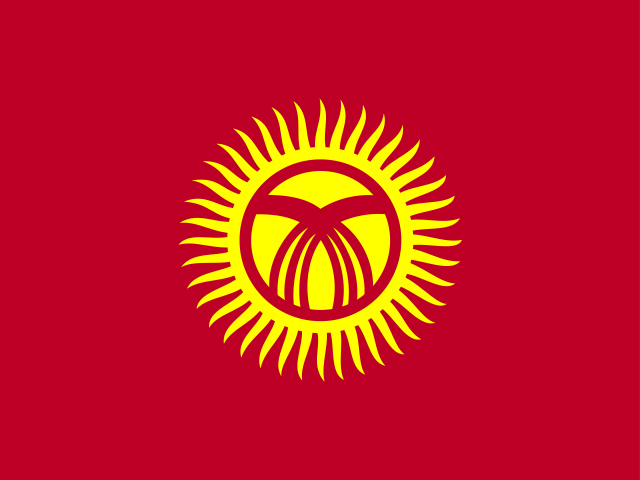
Kyrgyzstan
Kyrgyzstan’s hydro-rich energy sector is characterised by aging infrastructure and significant losses, which are exacerbated by a combination of weather-related shocks and growing demand. Energy policy aims to improve energy security by developing indigenous energy sources and rehabilitating and expanding transmission and distribution networks. Developing sustainable energy and improving energy efficiency are also priorities, while slowly removing subsidies will allow for further investment and expansion of domestic resources. Kyrgyzstan is part of the EU4Energy Programme, which is focused on evidence-based policymaking in the energy sector.
- Overview
- Energy mix
- Emissions
- Electricity
-
+ 5 pages

![Kyrgyzstan Flag]()
-
Renewables 2025
Analysis and forecasts to 2030 Renewables 2025 Renewables 2025 is the IEA's main annual report on the sector. It presents the latest forecasts and analysis, based on recent policy and market developments, while also exploring key challenges and opportunities facing the sector.This year’s edition provides forecasts for the deployment of renewable energy technologies in electricity, transport and heat through 2030. It also examines notable developments in key areas of the sector, including policy changes, manufacturing trends, and the financial health of different parts of the industry.