Cite report
IEA (2026), Energy Efficiency Policy Toolkit, IEA, Paris https://www.iea.org/reports/energy-efficiency-policy-toolkit, Licence: CC BY 4.0
Report options
Financing Energy Efficiency
Global energy investment continues to grow despite a challenging geopolitical environment. According to the IEA’s World Energy Investment 2026 report, total spending is expected to reach USD 3.4 trillion in 2026, a 5% increase from 2025. Clean energy investment is projected to remain around USD 2.2 trillion, representing nearly two‑thirds of total energy spending and continuing to outpace fossil fuels. Investment in electricity systems such as grids, storage, and electrification, is increasingly driven by energy security concerns and rising electricity demand. Energy efficiency also remains essential to strengthening system resilience, reducing costs for consumers and businesses, and lowering greenhouse gas emissions. Accelerating the uptake of efficient technologies across buildings, industry, and transport is therefore critical to maximising the benefits of the global energy transition.
Investment patterns, however, remain uneven. China, the United States, and the European Union continue to attract the bulk of clean‑energy capital, while many emerging and developing economies face persistent barriers, including higher financing costs and limited access to affordable capital. As a result, efficiency investment in these economies is growing far more slowly than in advanced economies and China. The IEA stresses the need to mobilise more finance, reduce investment risks, and expand suitable financing instruments to support the deployment of energy‑efficient technologies and infrastructure.
Energy investment in end use sectors, 2024 and 2030 Net Zero Emissions by 2050 Scenario
OpenHouseholds are the main investors in energy efficiency, more so than any other clean energy technology, accounting for 60% of all spending. This includes 70% of investments in buildings and half of all spending in the transport sector. In the industrial sector, the corporate sector accounts for around 60% of spending, with governments making up the rest. Between 50-60% of all efficiency investment spending is usually sourced from household savings or business equity, with debt finance making up the remainder. Financing solutions capable of supporting a large number of households are therefore particularly important to scale up investment in buildings and transport.
Policy package
Policy Packages – Financing Energy Efficiency
Growth in energy efficiency investment is lower than it needs to be, but enacting the right policies delivers social and economic benefits promptly, such as doubling the number of energy efficiency related jobs by 2030.
Policy can drive increased energy efficiency related investment and stronger action from the private sector. Although efficiency spending is increasing, it remains uneven, making stronger policies and improved access to affordable finance essential to accelerate progress across buildings, transport, and industry.

Achieving the goal of doubling global energy efficiency progress will require a larger share of total energy investment to be directed toward energy efficiency.
Regulation
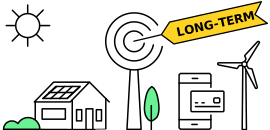
- Long-term strategies, targets and planning emphasise government commitments to sustained change, attracting private investment.
- Energy market structures can facilitate the participation of private actors, including energy service providers, supporting investment over time.
- Strong policy and governance frameworks including transparency regulations, Minimum Energy Performance Standards and ESG (Environmental, Social and Governance) requirements, can attract international investment and ensure the long-term flow of capital.
- Utility regulation can spur investment and enable innovative financing approaches e.g. where outlay is recouped through energy bills.
Information
- Training programmes and technical assistance for financial institutions and project developers help improve understanding of business models, risks and opportunities.
- Policies and digital tools enhancing data availability and quality, including energy performance certificates, help to improve financiers’ understanding, and to verify energy savings and payback periods.
- Development of standardised contract templates and terms help create trust, reduce transaction costs and simplify replication.
- Dedicated information campaigns raise awareness of preferential funding opportunities, and how to access them.
Incentives
- Streamlined and digitised administrative processes for energy efficiency projects, including permits, licences or subsidies and one-stop shops reduce barriers to investment.
- Public funding can support de-risking mechanisms, like guarantee funds or risk-sharing facilities, helping to attract private capital.
- Coordination platforms and matchmaking services between project developers and private investors can improve access to funding.
- Policies promoting innovative mechanisms such as bulk procurement, on-bill financing and leasing models can achieve scale and amplify actions.
- Energy subsidy reform helps phase out poorly targeted fossil fuel subsidies while boosting direct support for energy efficiency measures, including for vulnerable groups.
Financing solutions
Sustainability-linked loans: instruments where borrowers enjoy preferential terms depending on sustainability performance objectives. Such loans include predetermined key performance indicators (KPIs) linked to a set of calibrated (annual) sustainability performance targets that the borrower must meet. These targets can relate to reducing carbon emissions or improving energy efficiency. Borrowers are incentivised to achieve targets through potential benefits, such as reduced interest rates or other favourable loan terms.
Credit lines: loan facilities provided by commercial banks that are designed to aggregate many small projects that would otherwise not qualify for commercial finance on their own. By standardising project appraisal and loan processing, they reduce transaction costs. International financial institutions, governments, or bilateral donors would typically offer a long-term loan to a bank or a group of banks to target specific projects that increase energy efficiency. Commercial banks then on-lend the funds, or eventually their own capital, to their customers. They are responsible for marketing, delivery, and monitoring of individual loans.
Energy Service Companies (ESCO): services that provide comprehensive energy-saving solutions to customers, including arranging or securing finance. The primary goal of an ESCO is to help organisations reduce energy consumption and costs, often by improving energy efficiency or utilizing renewable energy sources. By financing the upfront costs of investments being repaid through energy savings, ESCOs make it easier for industrial clients to undertake large-scale energy efficiency improvements without having to incur additional debt.
Green Social Sustainability (GSS) bonds: type of fixed-income investment instrument to fund projects reaching positive environmental and social benefits.
Green insurance for energy efficiency: also referred to as eco‑insurance or sustainable insurance, is an emerging segment of the insurance market designed to support environmentally friendly practices, including renewable energy deployment, energy‑efficient buildings, and low‑carbon technologies.
Risk guarantee: financial instruments designed to mobilise private capital for energy‑efficiency projects by reducing credit, performance, and political risks that typically deter investors. A wide range of guarantee types exist, including partial credit guarantees, partial risk guarantees, and political‑risk insurance, offered by multilateral development banks, development finance institutions, export‑credit agencies, and specialised facilities.
Public Private Partnership (PPP): increasingly used as a mechanism to mobilise private capital and technical expertise for sustainable infrastructure, including energy‑efficiency and renewable‑energy projects. Many countries have adapted their energy policies and regulatory frameworks to encourage private investment through PPP structures, combining tools such as national renewable‑energy targets, feed‑in tariffs, grid‑access provisions, and competitive auctions to create stable investment conditions.
Green leasing: a form of lease with dedicated clauses covering a building’s environmental performance and the obligations of tenants and landlords to reduce energy use and waste. For building owners, taking a green lease is a way to meet minimum energy efficiency requirements, which may be set by governments.
Property Assessed Clean Energy (PACE): programmes that enable commercial and residential building owners to access upfront, long-term financing for clean energy building upgrades. The PACE financing model is based on a loan attached to a property instead of to an individual and is repaid with property taxes and charges.