-
Bioenergy
…sectors. Demand is due to expand in all regions, but it is concentrated in China, Brazil, Europe, India and the United States, which collectively support more than two-thirds of the forecasted growth. All five countries and regions have dedicated support policies for several – and, in some cases, all – renewable fuels. These vary by fuel, sector and country, but they often include a combination of mandates, greenhouse gas performance criteria, and incentives to invest in direct production and related assets.
Bioenergy – including liquid, gaseous and solid fuels – accounts for the vast majority (95%) of renewable fuel growth to 2030. New…
-
Greece
Greece is making progress on its energy transition, including implementing reforms to standardise and simplify licensing procedures for renewable projects and investigating options for offshore wind. Coal fired generation, once the main source of electricity, will be phased out by 2028 at the latest and EUR 5 billion has been committed to assist impacted communities. Auctions are driving strong deployment of solar PV, onshore wind and battery storage. There are also projects for interconnections and renewables to decarbonise electricity on Greek islands. However, more effort is needed boost electrification and improve efficiency in transport and buildings.
- Overview
- Energy mix
- Emissions
- Electricity
-
+ 5 pages

![Greece Flag]()
-
How governments can best support consumers during this energy crisis
How governments can best support consumers during this energy crisis The conflict in the Middle East has triggered a major shock to global energy markets, with the effective closure of the Strait of Hormuz triggering the largest supply disruption in the history of oil markets and significantly impacting supplies of natural gas and a range of energy-related commodities.As concerns over supply security have grown, prices have risen across several parts of the energy system, increasing pressure on household budgets, public finances and economic activity more broadly. In response, many governments have announced emergency measures to protect consumers from…
-
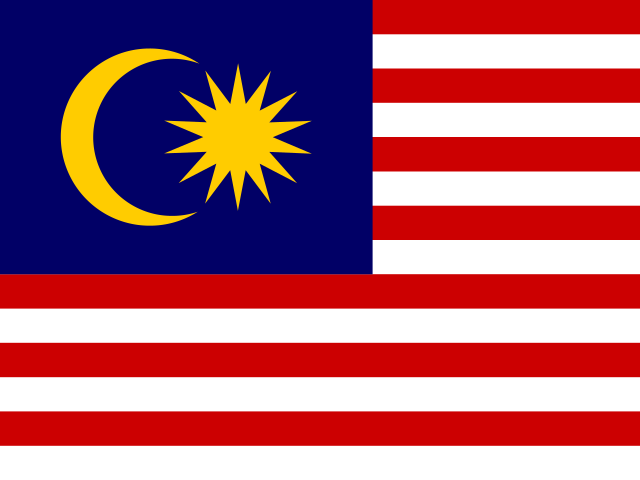
Malaysia
In Malaysia, the share of gas in the power mix decreased from 67% in 2005 to 47% in 2015, led by policies to switch to coal in response to declining domestic gas production. The country holds a large share of Southeast Asia’s fossil fuel resources.
- Overview
- Energy mix
- Emissions
- Electricity
-
+ 5 pages

![Malaysia Flag]()
-
Why the growth of energy service companies is uneven globally
ESCO The global annual ESCO market growth rate has more than doubled over the past five years Energy efficiency is one of the most cost-effective tools for enhancing energy security, reducing household energy bills and supporting countries’ efforts to reduce emissions. Energy service companies (ESCOs) – firms that develop and implement energy efficiency projects typically financed through verified energy savings – are playing a growing role in delivering energy efficiency improvements across buildings, industry and transport infrastructure worldwide. By integrating project development, financing and performance guarantees, ESCOs can offer a proven way to reduce upfront investment barriers and shift technical and…
-
Renewables 2025 Biogases
…economic growth. Global combined biogas and biomethane production is expected to expand 22% from 2025 to 2030 This represents a 4% increase in 2030 from last year’s forecast. Net growth will come from biomethane owing to its versatility and the opportunity to use natural gas grids and equipment, which could make it possible to displace fossil fuels for hard-to-electrify uses with minimum infrastructure investment. However, direct biogas use, mainly for electricity or combined heat and power (CHP) generation, remains a relevant growth driver in regions with limited gas pipeline infrastructure (e.g. Brazil, India and China). In…

-
Portugal
Portugal is supporting decarbonisation through a wide variety of measures, such as, coal-fired generation was phased out in 2021. Portugal is further developing its large hydropower fleet, including additional capacity of pumped hydro storage. Portugal is an international leader for integration of wind generation, and auctions are driving rapid deployment of PV and battery storage. Portugal is pushing for better electricity interconnections with the rest of Europe. Portugal’s National Energy and Climate Plan sets 2030 targets for emissions reductions, energy efficiency and renewable energy that aim to put the country a path to achieving cost effective carbon neutrality…
- Overview
- Energy mix
- Emissions
- Electricity
-
+ 5 pages
![Portugal Flag]()
-
Pledges to Progress 2025
An assessment of transparency of the oil and gas industry’s emissions reduction efforts At COP28, more than 50 of the world’s leading oil and gas companies launched the Oil and Gas Decarbonization Charter (OGDC), laying out a series of ambitions to achieve net zero operational emissions by 2050. As global methane and flaring emissions continue to rise, these ambitions are more important than ever to reduce energy waste and mitigate the harmful consequences of climate change.To support accountability and transparency, the International Energy Agency (IEA), the United Nations Environment Programme (UNEP) International Methane Emissions Observatory (IMEO) and…

-
Low-Emissions Fuels
Develop certification and standards to ensure that low-emissions fuels are sustainable
The development of standards and certification schemes ensuring a sustainable supply chain will be critical for scaling up the production of both biofuels and hydrogen, while avoiding potentially harmful environmental, economic and social impacts. The development of international markets and trade in these fuels will also depend on internationally agreed methods and certification processes to guarantee the sustainability of traded fuels.
Create support programmes for the use of low-emissions fuels
With the use of low-emissions fuels still in most cases being more expensive than unabated fossil…
-
Gabon
Almost two-thirds of the population of Gabon has access to electricity. The country can partially rely on its 150 thousand barrels per day hydrocarbon liquids production and has recently implemented a new petroleum legislation.
- Overview
- Energy mix
- Emissions
- Electricity
-
+ 5 pages

![Gabon Flag]()