-
Korea 2025 Executive summary
The energy crises resulting from the global Covid-19 pandemic and the Russian Federation’s invasion of Ukraine propelled carbon neutrality and energy security to the forefront of Korea’s energy policy. Despite robust growth in gross domestic product (GDP), Korea has managed to stabilise and reduce its greenhouse gas (GHG) emissions in recent years following a peak around 2018. Nonetheless, it faces challenges in fully decoupling emissions from economic growth. Notable among these challenges is the continued reliance on coal and the need for further expanding renewable energy technologies.Addressing Korea’s challenges will require sustained policy efforts, domestic…

-
Sustainable Transport for Georgia: A Roadmap Sustainable transport roadmap
Georgia faces major challenges in reducing transport emissions, but the transition to low-emissions, efficient systems offers significant environmental, social and industrial benefits. Heavy reliance on imported fossil fuels creates fuel price volatility, slows growth and raises geopolitical risks. Transport electrification and efficiency can substantially enhance energy security and resilience.This roadmap describes how Georgia can seize strategic opportunities from transport sector transformation. Doing so can bring health, mobility and job benefits while aligning Georgia with Paris Agreement commitments. Policy makers are working with corporate partners and supporting priorities set out in earlier plans, as shown by already completed or…

-
National Climate Resilience Assessment for Mozambique
Mozambique’s energy system has experienced significant disruptions due to extreme weather events, notably tropical storms and cyclones. With climate change, storms are projected to intensify, as are the risks of seasonal droughts and floods, posing a threat to the reliable operation of hydropower generation and the secure operation of the country’s coal mines. Mozambique’s plans to diversify its energy supply are an important step to enhance energy security and could be complemented by targeted measures to make its electricity system more resilient to natural hazards. Storms and tropical cyclones present the most regular extreme weather event faced…
-
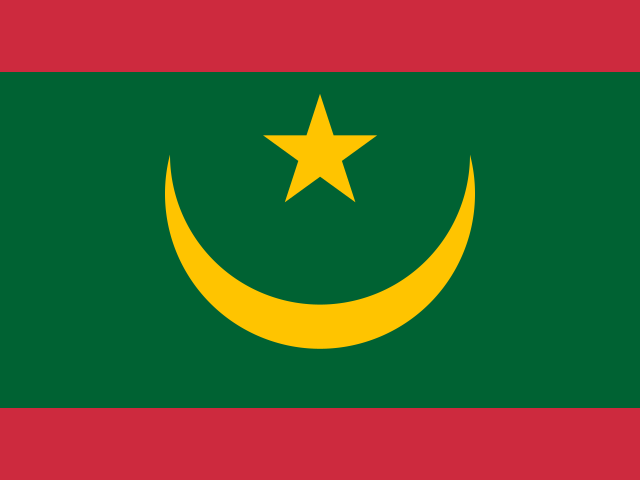
Mauritania
In 2019, Mauritania’s energy mix was dominated by oil products (65%) and biofuels and waste (32%). In 2020, 43% of the population had access to clean cooking which is the highest share in West Africa. In 2020, 47% of the population had access to electricity. For electricity access, the country targets universal access in urban areas and doubling of the current rate in rural areas by 2024, with country-wide universal access by 2030. For clean cooking, the target is 100% access to LPG in urban areas and 50% access to LPG in rural areas by 2030.
- Overview
- Energy mix
- Emissions
- Electricity
-
+ 5 pages

![Mauritania Flag]()
-
Global Critical Minerals Outlook 2025 Regional snapshots
Policymakers have woken up to these energy security challenges with a wave of new policy initiatives Governments around the world are intensifying efforts to secure critical mineral supplies through public funding, strategic partnerships and domestic policy reforms. In Europe, regulatory support and investments have ramped up to support critical mineral supply, supported by national investment funds and cross-border partnerships. North America is leveraging financial incentives to stimulate private-sector investment. Latin America, rich in critical minerals, is projected to reach USD 154 billion in mining and refining value amid regulatory reforms to attract foreign capital. China, already dominant, is…

-
Oil Market Report - September 2025
The IEA Oil Market Report (OMR) is one of the world's most authoritative and timely sources of data, forecasts and analysis on the global oil market – including detailed statistics and commentary on oil supply, demand, inventories, prices and refining activity, as well as oil trade for IEA and selected non-IEA countries. Highlights World oil demand is forecast to increase by 740 kb/d y-o-y in 2025, up marginally from last month's Report, with resilient deliveries in advanced economies contrasting with relatively muted consumption in emerging economies. OECD demand growth of 80 kb/d y-o…

-
Buildings
Buildings

-
The State of Energy Innovation 2026
The second edition of The State of Energy Innovation turns the spotlight on the technologies, policies and funders at the forefront of energy technology development. It provides a comprehensive assessment of recent progress and emerging challenges in energy technology innovation, drawing on over 150 innovation highlights from 2025 and a survey of practitioners across more than 40 countries. It analyses trends in public and corporate R&D spending, venture capital flows, patenting and policy, as well as providing an update on progress towards the 18 IEA Races to First in energy innovation. This data-driven approach informs policy makers, industry…

-
Universal Access to Clean Cooking in Africa
Progress update and roadmap for implementation Clean cooking access is a defining challenge for Africa’s prosperity. While the number of people without access to clean cooking has halved globally since 2010, the number in sub-Saharan Africa continues to rise. This harms health, economic development, and the environment – contributing to 815 000 premature deaths annually and significant deforestation.In a new report, Universal Access to Clean Cooking in Africa: Progress update and roadmap to implementation, the International Energy Agency (IEA) provides an updated picture of where things stand today, where efforts are gaining ground, and where urgent action is…

-
Energy and Gender
It comprises a number of senior officials from IEA Member countries, facilitating the exchange of best practices on gender equality and inclusion and gender mainstreaming across the energy sector. Women are vital energy consumers, producers and decision-makers who make a crucial contribution to global energy security and energy transitions. Building a more secure, fair and equitable energy future hinges on their active participation.Recognising this, the IEA’s Member countries have asked the Agency to focus on key issues at the nexus of energy and gender, from improving gender data collection to expanding analysis of the gender dimensions of…