Cite report
IEA (2026), The State of Energy Innovation 2026, IEA, Paris https://www.iea.org/reports/the-state-of-energy-innovation-2026, Licence: CC BY 4.0
Report options
Executive summary
Successful energy innovations can have outsize economic and social outcomes, impacting industrial competitiveness, trade, environmental health, infrastructure investment and security. The second edition of the State of Energy Innovation turns the spotlight on the technologies, policies and funders at the forefront of this process. Today, the global markets for energy technologies such as batteries, transformers, turbines, motors and heat exchangers are worth trillions of dollars. With spending on energy representing as much as 10% of global GDP, innovation that reduces energy supply costs can transform a country’s comparative advantage. As a result, the energy sector is innovation-intensive: one in ten patents is related to energy – more than for chemicals, pharmaceuticals or transport.
Today, the context for energy innovation tilts towards competitiveness and security. In our survey of experts and practitioners, 80% of respondents placed energy security among the top three drivers of energy innovation in 2025, ahead of affordability, GHG emissions and national economic performance. Many of the innovation-relevant policies announced in 2025, including the US Genesis Mission and the proposed EU Competitiveness Fund, promote technological strength for economic competitiveness and energy security. This may boost technologies that support critical minerals supplies, nuclear, power grids, and domestic energy resources.
The value of public spending on energy innovation can be seen in market outcomes
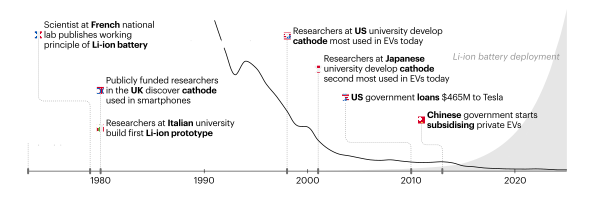
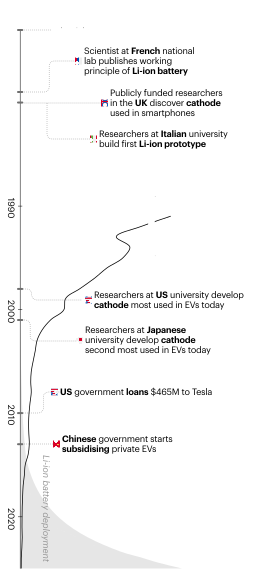
Public energy innovation support is behind some recent, major steps forward in the energy sector, and pays off for decades into the future. Lower project costs and new designs have brought investment to floating liquefied natural gas (FLNG), which is expected to deliver more than one-eighth of global LNG capacity by 2030, from zero just 10 years ago. Initial FLNG design and testing was funded by European governments in the late 1990s, and the European Union and Japanese government shared funding risks with the private sector on the first major project. Similarly, lithium-ion battery research was initially publicly funded in the 1970s, and the first patent was funded by the UK Government in 1981, before policy support fostered markets that drove further improvements. In the absence of private sector capital for next-generation geothermal development – a long-term project with high risks that is now starting to translate into major investments – governments funded nearly all the initial work from the 1970s to the 2010s.
Cost-benefit evaluations typically show that the economic benefits of public energy R&D are far greater – even a hundredfold larger – than their costs. The most complete retrospective evaluations of this kind followed several multi-decade US programmes up to 2015. These programmes generated benefits to the US economy at least three times greater than their costs, including fuel expenditure savings, lower prices for energy equipment and higher sales of energy products. Examples such as R&D for geothermal, wind and buildings efficiency resulted in several hundreds of dollars in benefits for every dollar of cost. The impacts of many of these initial investments are likely to have grown since these analyses were conducted, as markets for the resulting products expanded, and “spillovers” to adjacent areas spurred new ideas and inventions around the world.
Energy innovation strengths and industrial strengths can reinforce one another. Analysis of different countries revealed technology advantages (RTA)1 in energy technologies shows that the world’s largest fossil fuel producers now have the highest specialisation in fossil fuel technologies, and countries that invested early in wind power now have the highest advantages in wind energy patenting. However, technical specialisation does not automatically translate into industrial competitiveness; it requires close attention to manufacturing advantages, and strategic trade or knowledge partnerships.
A dynamic time for energy innovation
Across a range of indicators, extensive innovation activity is visible around the world. We identify over 150 significant energy innovation highlights in 2025, in areas including solid-state air conditioning, perovskite solar, fusion energy, sodium-ion batteries and next-generation geothermal. These advances led to 50 upgrades of technology readiness levels for emerging energy technologies followed by the IEA. Among the IEA Races to First that track progress towards 18 energy breakthroughs, frontrunner projects propelled 3 races into a higher phase. The report also identifies more than 80 new energy innovation policies introduced in 2025, as well as over 60 new initiatives issued under existing policies across 32 countries and jurisdictions. According to the latest patent data, energy occupied a higher share of all patents in 2023 than in the year before. Over 320 new energy start-ups raised their first funding in 2025, a signal of an active ecosystem.
However, uncertainty abounds as markets for some clean energy technologies weakened. For example, project delays and cancellations reduced expectations for the deployment of low-emissions hydrogen this decade. The IEA’s renewables deployment forecast for 2030 was downgraded by 5% in 2025 in response to policy and regulatory changes. Several major first-of-a-kind energy technology projects under construction, in areas such as near-zero emissions steel and direct air capture, required emergency funding packages or job cuts to cope with higher costs and policy uncertainty. The US federal energy R&D budget dipped by 8% in 2025 and some budgeted spending was paused or cancelled as research priorities came under review, leaving some researchers and project developers short of funds or pivoting towards different markets.
Funding shows signs of being in transition
After years of growth, energy innovation funding appears to be entering a phase marked by slower growth and shifting priorities. Public energy R&D spending globally in 2024 dropped from its recent high point in 2023, and our estimate for 2025 is down a further 2% to USD 55 billion. This is partly due to large recent commitments to demonstration projects from the 2023 EU budget, but also reflects cuts in the US federal budget. In total, public energy R&D spending in IEA Member countries stands at around 0.05% of GDP, far lower than the 0.1% seen in the aftermath of the 1970s oil shocks as countries sought to diversify their energy systems, though there are significant regional variations. At 1%, growth in corporate energy R&D was slower than in any year since 2015 (except for pandemic-hit 2020). It stood at USD 160 billion in 2024, the last year for which data is available. VC investments in energy technology start-ups shrank for the third year straight in 2025, to USD 27 billion.
Government spending on energy research and development, 2015-2025
OpenThere is no single reason for the decline in energy VC funding since 2022. Higher interest rates and an uncertain macroeconomic environment were initially leading factors. They encouraged investors to make fewer investments and to wait longer before investing, which cut larger, late-stage deals. VC markets have now partly rebounded but, in 2025, energy start-ups faced stiff competition for capital from AI firms: the share of VC funding for AI rose to almost 30% in 2025, while the share of energy shrank, and large non-specialist VC funds shifted focus from energy to AI. The post-peak decline in electric mobility VC is another factor – without this, energy VC in total would have been nearly flat.
New growth areas for energy VC are taking shape, and they reflect shifting priorities. Seven technology areas – carbon dioxide removal, critical minerals, next-generation geothermal, low-emissions industrial production, aerospace, nuclear fission and fusion energy – have offset most of the decline in electric mobility VC funding since 2021. From 2015-2019, these seven areas represented less than 5% of total energy VC funding (of which aviation accounted for half); in 2025, they represented one-third of the total funding.
Total venture capital investment across all sectors, 2015-2025
OpenThe share of energy patenting going to batteries is unprecedented
If patenting is a leading indicator of technological change, battery innovation will remain a disruptive force in the energy sector and beyond. The share of energy patenting represented by energy storage is rising, reaching 40% in 2023. Based on preliminary data, this is set to grow further in 2024 and 2025. Our analysis suggests that no other energy technology has ever commanded such a dominant share, reflecting the strategic importance of batteries for modern energy security, industrial policy and grid infrastructure, as power demand surges globally. China, Korea and Japan remain the leading sources of lithium-ion battery patents, though their relative contributions have shifted. In 2010, Japan filed half of all cathode-material patents; by 2022 its share had fallen to below 10%. Over the same period, China’s share rose from 4% to almost 40%.
Energy patents by technology in the world, 2000-2023
OpenMature technology areas do not stand still. Since 2010, patenting for crystalline silicon PV has fallen while patenting for solar perovskite has grown, and it now accounts for over 70% of all solar cell patents. China leads perovskite patenting globally, followed by Korea and Japan. In 2025, perovskite reached several innovation milestones, including the world’s first 33% efficiency solar cell at marketable dimensions. While it is not expected to displace crystalline PV, it could expand the total market for PV.
Regional trends are diverging
China’s pursuit of innovation-led growth is seen in its funding, patenting and technology milestones. Higher spending on energy R&D by Chinese companies explains almost all the growth in corporate energy R&D globally over the past decade, and they now account for 60% of corporate R&D for the energy supply and infrastructure sectors. China’s public energy R&D spending is on par with Europe’s, but its patenting is now far larger: Chinese inventors made double the number of applications for international energy patents in 2023 compared with 2020, reaching twice the level of the United States, Japan or Europe. Patenting is especially focused on energy storage and industrial energy efficiency. China achieved multiple innovation milestones in 2025, including extending the record for perovskite solar tandem cell efficiency, demonstrating the first kilowatt-scale solid-state air conditioning, and planning the first 50 MW floating wind turbine.
Energy patenting of the five countries with the most applications, plus Europe, 2015-2023
OpenEurope has steadily risen closer to 0.1% of GDP spent on energy R&D. Revised EU data for public R&D spending show Europe pulling away from the United States and Japan in recent years, and reaching 0.08% of GDP. Energy efficiency and nuclear technologies represented over half of the USD 19 billion of European public energy R&D spending in 2024. The region’s energy innovation ecosystem is also becoming more dynamic: European start-ups accounted for 25% of global energy VC in 2025, compared with 15% five years before, and Europe was home to more than 40% of energy start-ups raising their first funding round. However, energy technology patenting in major European countries has dipped, according to the latest data, and European start-ups typically raise less than their US counterparts. Nonetheless, a large share of the innovation highlights identified for this report took place in Europe, including for fusion energy, underground hydrogen storage, industrial electrification, power grid stabilisation, CO2 storage, synthetic fuels and methane detection. Of the projects in the more advanced phases of the IEA Races to First, 40% are in Europe.
The United States continues to be an energy innovation powerhouse. A reorientation of energy R&D priorities is underway, while many of the underlying strengths of the US energy innovation ecosystem persist. US energy innovation spending is more equally spread between government, corporations and VC investors than in other countries. Nearly 50% of global energy VC in 2025 was raised by US start-ups, a higher share than in 2024, largely funded by US-based investors. US energy technology patenting is also distributed across multiple technology areas. Among the US innovation highlights in 2025 were the largest solid-state thermal battery, more reliable geothermal drilling, improvements to lithium‑ion batteries with reduced nickel and cobalt, and investments in novel aviation designs. Of the projects in the more advanced phases of the IEA Races to First, 20% are in the United States.
Global deployment, price, and key milestones for lithium-ion batteries, 1973-2025
Japan’s innovators are racing to stay ahead in batteries. Japan’s energy patenting is heavily skewed towards batteries, including advanced chemistries. Japan has the highest RTA in batteries of any major economy, just ahead of Korea, whose battery RTA has declined since 2020. A Japanese company is among the leaders in the IEA Race to First for a solid-state battery car. After China, Japan patents more in low-carbon energy areas than any other country and the whole of Europe. Thanks to stable spending, including the R&D component of the USD 75 billion Green Transformation fund, Japan is well-placed in emerging areas, such as solar perovskite, fusion, and hydrogen-based fuels – a Japanese company completed the first full-scale testing of an ammonia ship engine in 2025.
Fusion and grid technologies show the wide spectrum of energy innovation challenges
Future electricity grid resilience can be ensured with technology, thanks to recent, farsighted R&D, especially from governments. Recent major blackouts are a warning that grids must be more resilient to events including natural hazards and unplanned changes in power supplies. If not addressed, these challenges will undermine economic growth, national security and quality of life for citizens around the world. Several cutting-edge technologies – like grid-forming inverters, solid-state transformers and long-duration energy storage – have been developed in government programmes in recent years and are now proven solutions, alongside market and regulatory reforms. However, unless governments can address systemic regulatory disincentives to the deployment of innovative technologies, they will fail to deliver their potential.
Number of grid technology start-ups founded, 2010-2025
OpenGigawatts of fusion power remain some time away, but long-standing international co-operation in public R&D has brought it to the cusp of demonstration. Fifty years after the IEA began supporting international co-operation on fusion, major experimental milestones were reached in 2025 in government-funded facilities in China, France, Germany, the United Kingdom and the United States, by consortia involving over 30 other countries. These advances have raised hope of a radically different way to power a future economy in the age of electricity, and there is stronger interest from funders – fusion start-ups have raised USD 10 billion since 2020, over 5% of all energy VC funding, and many are also funded by multiple governments. However, a clear-sighted view of the challenges is necessary: despite recent attention to engineering the first integrated fusion energy plants, the fuel cycle and materials are still not ready for scale-up. This introduces a possible tension between considering fusion energy as a race for first-mover advantages, and the benefits of cross-border collaboration that can continue to enable rapid scientific progress. There will be value in funding ways to share the daunting costs and construction hurdles that could limit the pace of deployment in any single region.
Announced start years for electricity-generating fusion plants, 2025-2055
OpenEven as the aims of energy innovation policy diverge, the policy priorities remain the same
The findings of this report highlight the continued importance of continuous, converted policy action. In particular, they show the relevance of public spending on energy R&D and early commercial projects for a range of key policy goals, especially as private finance has become scarcer. The enduring potential of innovation holds significant value for long-established and breakthrough areas.
The many energy innovation policies that have been released or updated in the past year reflect progress against the ten priorities for policy makers identified in last year’s edition of this report, but also more policy volatility in some regions. The full set of ten priorities remains a good near-term guide to providing policy stability and realising long-term impact. However, against a backdrop of uncertainty and competing demands for the attention of governments and investors, we highlight three areas of action that have special relevance for the coming year.
Target synergies between competitiveness, resilience & energy technology. Identifying how energy-related challenges are holding back domestic investment in key industries and supporting a range of potential solutions will be important. Another approach could be to pinpoint comparative strengths to ensure that innovators can excel in international markets and reinvest in domestic value chains. In a more fragmented world, innovation support must consider technologies up and down the supply chain from major energy innovation projects.
Tailor funding to address current financial weaknesses. Continuous access to funds across all innovation stages must be ensured if energy innovation is to reliably address policy goals. For example, if private funds for scale-up are gravitating to AI projects, the public sector can intervene temporarily in the interest of long-term outcomes. If VC investors continue to be wary of giving early-stage energy technologies a chance, innovators may benefit from finance, demand signals or fiscal incentives to draw in private capital. Reaching 0.1% of GDP on public energy R&D is achievable with a range of tools, tailored to the risks of failure that are inherent to innovation.
Bolster partnerships, networks and matchmaking. The connective tissue of the innovation ecosystem should be strengthened, both internationally and across sectors. At a time when some traditional linkages are fraying, strong networks are crucially important for maintaining speed and efficiency. Innovation depends on the ready exchange of knowledge, skills and capital. The role of agencies and initiatives that connect researchers, entrepreneurs and first-of-a-kind project developers with expertise, risk-tolerant customers and funding will be especially important this year.
References
This indicator reflects how specialised a country is in a given technology. It is calculated as the share of a country in patents in a particular technology divided by the country's share in all patents. An RTA greater than 1 indicates specialisation.
Reference 1
This indicator reflects how specialised a country is in a given technology. It is calculated as the share of a country in patents in a particular technology divided by the country's share in all patents. An RTA greater than 1 indicates specialisation.