-
Financing Electricity Access in Africa
Access to electricity is a cornerstone for economic development, poverty reduction and social equity. However, almost 600 million people in Africa lack access to electricity today, with progress falling far behind targets set by both African governments and the international community. Reaching universal electricity access will require a rapid scale-up of investment and financing to USD 15 billion per year, enabling the expansion of generation capacity, grid networks and decentralised solutions while ensuring that progress remains inclusive and sustainable.In a new flagship report, Financing Electricity Access in Africa, the International Energy Agency (IEA) undertakes its authoritative energy analysis…

-
Coal Mid-Year Update 2025 Trade
…Russia’s thermal coal trade faced headwinds. Western sanctions, logistical disruptions, and declining profitability contributed to a significant decline in Russian thermal coal exports.Global trade in metallurgical coal reached an all-time high of 369 Mt in 2024, supported by strong demand from key steel-producing countries in Asia. Australia, the world’s largest exporter of metallurgical coal, maintained stable export volumes at 153 Mt. Mongolia, the second-largest exporter, recorded a 5% increase, reaching 56 Mt, with all volumes directed to the Chinese market. The United States and Russia increased exports by 11% each to 52 Mt and to…

-
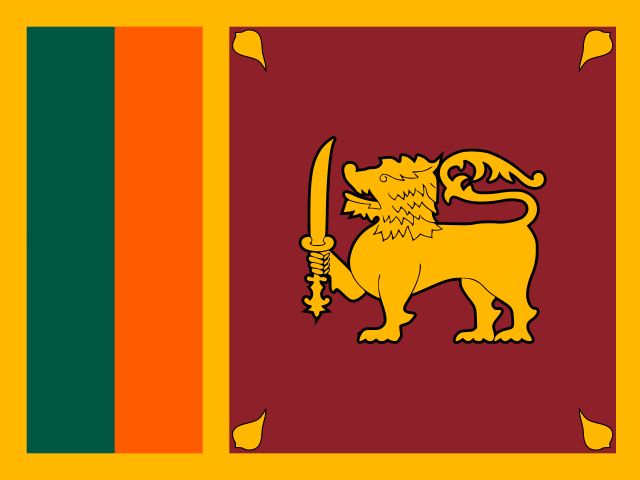
Sri Lanka
Sri Lanka’s primary energy supply mainly comes from oil and coal. Almost 40% of Sri Lanka’s electricity came from hydropower in 2017 but coal’s shares in power generation has been increasing since 2010. Sri Lanka is reaching universal access to electricity but clean cooking remain an issue with 15 million people still relying on biomass to cook.
- Overview
- Energy mix
- Emissions
- Electricity
-
+ 5 pages

![Sri Lanka Flag]()
-
World Energy Investment 2025
This year’s World Energy Investment report, marks the 10th edition of this flagship analysis and provides a full update on the investment picture in 2024 and an initial reading of the emerging picture for 2025.The report provides a global benchmark for tracking capital flows in the energy sector and examines how investors are assessing risks and opportunities across all areas of fuel and electricity supply, critical minerals, efficiency, research and development and energy finance.The report highlights several key aspects of the current investment landscape in the context of recent policy and macroeconomic developments and a heightened focus…

-
National Climate Resilience Assessment for Algeria
Algeria’s energy system already faces significant disruption due to extreme weather events. Critical infrastructure has been impacted in recent years by flash floods, drought-induced wildfires and heatwaves. With the climate projected to warm more rapidly than the global average, these risks are likely to intensify. Proactive measures to enhance the resilience of Algeria’s energy system could offer substantial benefits.Algeria has experienced significant warming, averaging 0.49 °C per decade from 2000 to 2023 and exceeding the global average of 0.37 °C per decade. Temperatures are expected to rise further, reaching up to 5.6 °C above pre‑industrial levels…
-
Sustainable Transport Policy for Armenia: A Roadmap Accelerating sustainable transport
Amid a rapidly changing energy landscape and mounting environmental pressures, Armenia faces both an urgent challenge and an opportunity to reshape its transport system. As it seeks to balance the twin goals of enhanced energy security and reduced dependence on imported fossil fuels, Armenia has made the transition to sustainable transport a top priority.This chapter lays out a forward-looking framework designed to accelerate Armenia’s shift to an efficient, low-carbon and resilient transport system. Drawing on international best practices, the recommendations focus on three interconnected priorities: electrifying the road transport fleet, boosting overall transport system efficiency and…

-
Iron and steel
Iron and steel

-
Tracking SDG7: The Energy Progress Report, 2026
This report is published by the SDG 7 custodian agencies, the International Energy Agency (IEA), the International Renewable Energy Agency (IRENA), the Statistics Division of the United Nations Department of Economic and Social Affairs (UN DESA), the World Bank, and the World Health Organization (WHO), and aims to provide the international community with a global dashboard to register progress on energy access, energy efficiency, renewable energy and international cooperation to advance SDG 7.

-
Chinese Taipei
The Taiwanese government enacted in the late 2010s the Statute for Renewable Energy Development to reduce CO2 emissions, improve energy diversification and promote green-energy industries. The government is seeking to generate 8% of electricity from renewables by 2025.
- Overview
- Energy mix
- Emissions
- Electricity
-
+ 5 pages
![Chinese Taipei Flag]()
-
Electrolysers
Country and regional highlights
Progress is spread across different continents, from China, which leads on installed capacity, to the European Union, which have adopted important policies, and other regions like India and the Middle East moving forward with a small number of large-scale projects
Technology deployment
Global installed electrolyser capacity reached 1.4 GW at the end of 2023, almost double the one at the end of 2022
Technology manufacturing
Innovation
Policy
Investment
Acknowledgements