-
COP28: Tracking the Energy Outcomes
The latest IEA data and analysis on global action to meet the energy goals set at COP28 Nearly 200 countries made major collective pledges on energy at the COP28 climate summit in Dubai with the aim of keeping within reach the Paris Agreement target of limiting global warming to 1.5 °C. For the first time, governments explicitly recognised that to achieve this target, energy-related emissions need to reach net zero by 2050, and they set key goals to help meet this objective – including tripling global renewable energy capacity and doubling global energy efficiency improvements by 2030, and deploying emerging technologies…
-
World Energy Investment 2025 Latin America and the Caribbean
Clean energy investment in Latin America has grown by nearly 25% in the past decade, highlighting regional progress despite diverse country contexts and transition pathways In Latin America and the Caribbean, a region characterised by diverse economic, political, and energy landscapes, GDP grew by 15% between 2015 and 2025, driven by Mexico, Colombia, Chile and Costa Rica, which experienced increases of between 10% and 40%. Since 2015, clean energy investment increased by nearly 25%, reaching USD 70 billion in 2025. Chile, Colombia and Costa Rica accounted for the largest increase, given the doubling of renewable investment flowing into the three countries. Brazil…

-
World Energy Outlook 2022 Key findings
Introduction Each energy crisis has echoes of the past, and the acute strains on markets today are drawing comparison with the most severe energy disruptions in modern energy history, most notably the oil shocks of the 1970s. Then, as now, there were strong geopolitical drivers for the rise in prices, which led to high inflation and economic damage. Then, as now, the crises brought to the surface some underlying fragilities and dependencies in the energy system. Then, as now, high prices created strong economic incentives to act, and those incentives were reinforced by considerations of economic and energy security.But…

-
Gaining an Edge Energy demand and competitiveness
Energy is at the centre of competitiveness amid high costs, growing demand, and rising trade pressures Energy is a vital input into all productive sectors of the economy. In an environment of fierce global competition and shifting trade patterns, energy costs are a major determinant of long-term investment, jobs and business competitiveness. Finding ways to reduce energy costs while producing more or better products is good for both profitability and overall economic growth. While energy prices are volatile in many countries, recent high prices combined with instability and fragmentation in energy markets have widened energy price gaps between regions…

-
Sustainable Transport for Georgia: A Roadmap Sustainable transport roadmap
Georgia faces major challenges in reducing transport emissions, but the transition to low-emissions, efficient systems offers significant environmental, social and industrial benefits. Heavy reliance on imported fossil fuels creates fuel price volatility, slows growth and raises geopolitical risks. Transport electrification and efficiency can substantially enhance energy security and resilience.This roadmap describes how Georgia can seize strategic opportunities from transport sector transformation. Doing so can bring health, mobility and job benefits while aligning Georgia with Paris Agreement commitments. Policy makers are working with corporate partners and supporting priorities set out in earlier plans, as shown by already completed or…

-
Montenegro
The Energy Development Strategy of Montenegro sets out objectives and defines mechanisms for the transition from the current energy system to a safe, competitive and environmentally acceptable energy paradigm by 2025. It also provides guidelines for the development of the energy sector with the aim of attracting investors.
Data for Montenegro is included under Serbia until 2004.- Overview
- Energy mix
- Emissions
- Electricity
-
+ 5 pages

![Montenegro Flag]()
-
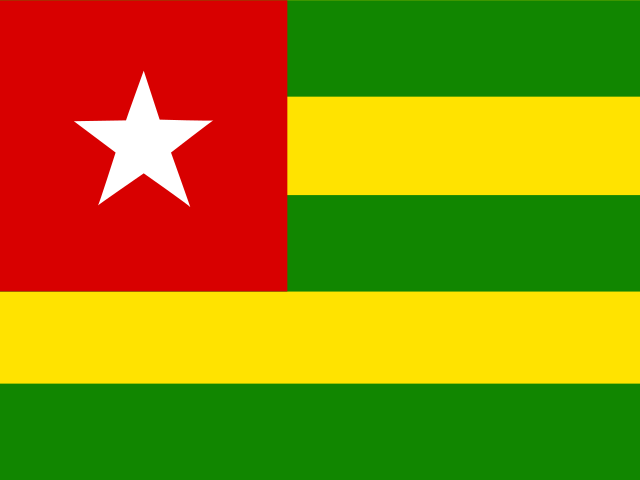
Togo
Less than half of the Togolese population has access to electricity. The country has a relatively diversified energy mix and more than 13% of its final energy consumption comes from renewable supplies of energy, mainly hydropower.
- Overview
- Energy mix
- Emissions
- Electricity
-
+ 5 pages

![Togo Flag]()
-
World Energy Outlook 2025 Regional insights
Diverse priorities, diverse pathways This chapter explores energy sector trends and priorities in countries and regions that cumulatively account for around 90% of the world’s population, GDP and energy demand. Priorities, objectives and national circumstances vary widely between and within regions, but two trends that are visible in most parts of the world are a rise in the electrification of end-uses, and a rise in the share of renewables in electricity generation. Energy trends in advanced economies are shaped by the structure of their economies, and by high average incomes and rates of vehicle and appliance ownership. Overall…

-
Financing Electricity Access in Africa Beyond new connections
Providing an affordable, equitable and quality service Affordability constraints can prevent households from gaining access to electricity or from taking advantage of electricity services once a connection is made. An estimated 220 million people in sub-Saharan Africa (around 40% of those without access) would find the basic bundle unaffordable, rising to 400 million for the essential bundle (65% of those without access). Filling this affordability gap would cost an additional USD 2-10 billion per year, via supply-side subsidies to reduce developer costs, demand-side subsidies to reduce consumer costs, or reductions in financing costs.The cost of capital for electricity access projects…

-
Kenya
Access to electricity has increased dramatically in Kenya over the past 20 years, reaching almost 3/4 of the population today. The Last Mile Connectivity Project of the Rural Electrification Authority aims to deliver universal access by 2022.
- Overview
- Energy mix
- Emissions
- Electricity
-
+ 5 pages
![Kenya Flag]()