-
Matthieu Prin
Programme Coordinator.

-
An Energy Sector Roadmap to Net Zero Emissions in Colombia Executive summary
Colombia is one of the region’s growth success stories Colombia is the third-largest country in Latin America and the Caribbean (LAC) by population, with 53 million inhabitants. Its economy has grown steadily since 1971, even during the “lost decade” experienced by LAC in the 1980s, and with very few exceptions during global crises. GDP has increased by an annual average of 2.4% since 2015, outpacing the regional average of 1.2%. This growth has been accompanied by tangible improvements in indicators of living standards for Colombia’s population: access to clean cooking and electricity have significantly improved, both standing…

-
Global Energy Review 2026 Oil
Oil demand growth remained subdued in 2025 Oil demand increased in 2025 by 0.65 mb/d (million barrels per day) or 1.2 EJ, but this 0.7% rise marked a further slowdown from 2024’s already-muted 0.75 mb/d of growth. The increase in both years was in line with IEA projections. The 2025 increase fell well short of the 2010-19 average annual rise of 1.4 mb/d, offering further evidence of a structural deceleration in oil markets.This slowdown mainly reflected weaker growth in petrochemical feedstock use. Demand for naphtha, liquefied petroleum gas…
- Key findings
- Global trends
- Oil
- Natural gas
-
+ 9 pages

-
Sheltering From Oil Shocks Introduction and context
The conflict in the Middle East has created the largest supply disruption in the history of the global oil market. The volume of fuel supply offline now is higher than the supply loss during the oil shock of 1973 that led to the IEA’s creation and any disruption since then. Beyond the direct damage to energy infrastructure in the region, the crisis has led to a near halt in tanker movements through the Strait of Hormuz. Crude and oil product flows through the Strait have fallen from around 20 million barrels per day (mb/d) before the conflict to…

-
Michel Heijdra
Vice Minister for Climate and Energy Policy.

-
China’s Official Energy Finance in Emerging and Developing Economies Case 7. Palembang waste-to-energy plant
Project overview and impact Indonesia faces a dual challenge of rapidly growing waste volumes and persistent electricity supply constraints. The country generates around 65 million tonnes of waste annually, yet only about 20% is formally treated, and most cities rely heavily on landfills. In 2017, the government designated 12 priority cities for accelerated waste-to-energy (WTE) development, including Palembang, and introduced preferential feed-in tariffs and guaranteed waste-tipping fees to attract private investment. Despite this, only two WTE plants, Surabaya’s Benowo PLTSa and Surakarta’s Putri Cempo PLTSa, both on Java island, were operational before 2024, highlighting…

-
State of Energy Policy 2026 Climate pledges
The new round of NDCs does not imply stronger annual emissions reductions than the previous 2030 NDCs The past year marked a key milestone in the Paris Agreement’s ratcheting mechanism, under which countries update their climate pledges every five years. As of 27 March 2026, more than 130 countries had submitted new NDCs out of the 194 parties to the Paris Agreement that had previously submitted NDCs under the UNFCCC framework, with the vast majority setting new targets for 2035. In total, these submissions cover close to 75% of today’s energy-related greenhouse gas emissions.Some regions have not…

-
Copper prices have hit record highs, but smelters face mounting strategic pressures
copper Copper markets enter uncharted territory as structural and short-term pressures converge Copper prices have surged to record highs this year, briefly exceeding USD 14 500 per tonne (intraday) in January 2026, having only passed USD 12 000 per tonne for the first time in December 2025. The unprecedented price levels have been driven by some important short-term developments, including supply disruptions at several major mines and a build-up of US copper inventories due to tariff uncertainty. But they have also been underpinned by some underlying factors, such as challenges in developing new copper mines and the…
-
Cost of Capital Observatory Dashboard
Overview The dashboard is a free resource that provides data on the cost of capital focused on clean energy projects in emerging and developing economies. It also provides information of the main underlying risks perceived by investors and financiers in each country as well as case studies. We hope these resources will help drive policy changes that can lower financing costs in the parts of the world that most need it. For additional information on how to estimate the cost of capital, this IEA article highlights the importance of financing costs in the energy transition, defines what financing costs are (also commonly…

-
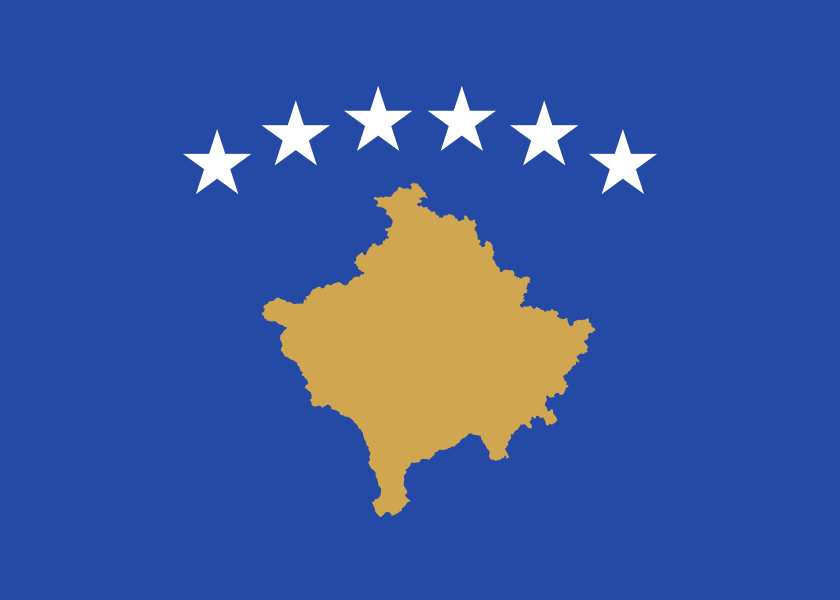
Kosovo
This designation is without prejudice to positions on status, and is in line with United Nations Security Council Resolution 1244/99 and the Opinion of the International Court of Justice on Kosovo’s declaration of independence.
- Overview
- Energy mix
- Emissions
- Electricity
-
+ 5 pages

![Kosovo Flag]()