Cite commentary
IEA (2026), Copper prices have hit record highs, but smelters face mounting strategic pressures, IEA, Paris https://www.iea.org/commentaries/copper-prices-have-hit-record-highs-but-smelters-face-mounting-strategic-pressures, Licence: CC BY 4.0
Copper markets enter uncharted territory as structural and short-term pressures converge
Copper prices have surged to record highs this year, briefly exceeding USD 14 500 per tonne (intraday) in January 2026, having only passed USD 12 000 per tonne for the first time in December 2025. The unprecedented price levels have been driven by some important short-term developments, including supply disruptions at several major mines and a build-up of US copper inventories due to tariff uncertainty. But they have also been underpinned by some underlying factors, such as challenges in developing new copper mines and the anticipation of strong demand growth from electrification and artificial intelligence (AI). Lower interest rates, a softer dollar, a broader investor shift into physical assets and significant financial speculation have also amplified upward pressure on prices.
The confluence of forces shaping today’s copper market – strong structural demand growth and elevated prices – may be good news for producers. However, today’s situation is unusual in that the crucial midstream sector is showing increasing signs of stress, amid a surge in smelter capacity additions in China.
Copper monthly average price, 1990-2026
OpenCopper is set to face a major supply deficit of 30% by 2035
Copper – a highly conductive metal that is resistant to corrosion – is at the heart of a more electrified energy system. As the world enters an Age of Electricity, strong demand growth for copper is anticipated from a wide variety of sources, including grids, electric vehicles, construction, industry and data centres. However, despite the robust demand growth outlook, there are major challenges in increasing copper supply. Based on the current project pipeline, the IEA anticipates that the copper market could face a supply deficit of 30% by 2035.
The challenges around developing new copper supply are driven by declining copper ore grades – the average global grade of copper mines has decreased 40% since 1991 – rising capital costs and increasing project complexity. The average capital intensity for expanding existing projects (brownfield) has also increased by 65% since 2020, approaching levels typically associated with new greenfield projects. These challenges are compounded by a rapidly declining rate of new resource discoveries. Of all the copper deposits discovered in the last 35 years, only 5% have been in the last decade. Finally, lead times for new copper projects are long – around 17 years from discovery to production – and many major projects have recently experienced significant delays and cost overruns. These dynamics suggest a structurally tighter market for copper concentrate (raw materials for smelters), raising risks for supply security and underscoring the need for supply- and demand-side measures – from stimulating investment in new mines to advancing material efficiency, substitution and recycling.
Mined supply and demand outlook for copper, 2026-2035
OpenDespite record copper prices, smelter fees have fallen to record lows, underscoring deepening risks for the midstream sector
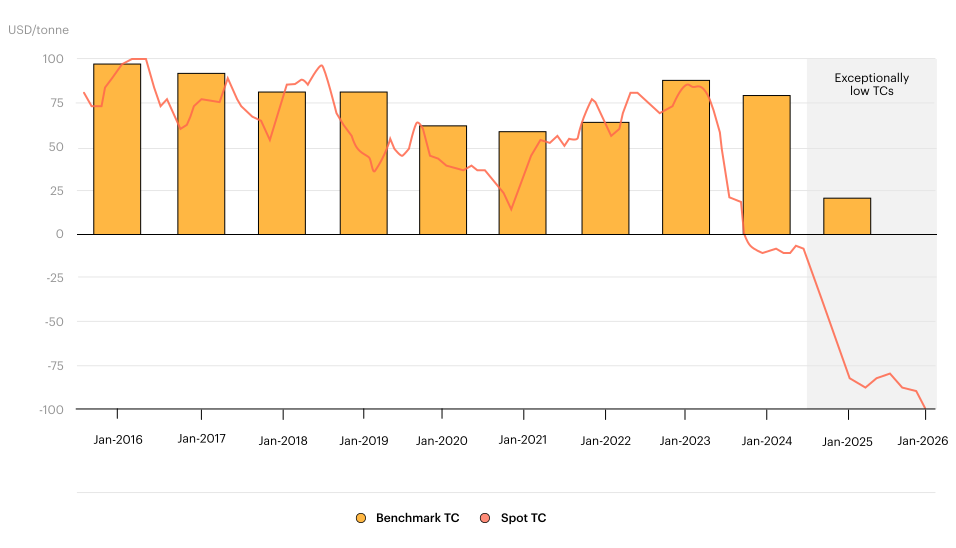
Despite record high copper prices, the copper midstream market is facing major challenges. Smelter fees for processing copper concentrate, known as treatment and refining charges (TC/RCs), have hit all-time lows. The annual TC/RC benchmark, which is based on an agreement between Chilean miner Antofagasta and major Chinese smelters, settled at USD 0 per tonne in January 2026, the lowest level ever agreed in annual negotiations. Meanwhile, spot TC/RCs have been negative since 2024 and fallen to all-time lows. These dynamics have been driven by a surge in smelter capacity additions from China, which has significantly outstripped growth in copper concentrate production. As a result, competition among smelters for concentrate has ramped up, sharply weighing on smelter fees. Since 2005, China has accounted for over 90% of growth in global copper smelter output, lifting its share from around 15% to half of global supply in 2025.
Copper smelter treatment and refining charges, 2016-2026
Open
High by-product prices are protecting copper smelters for now…
The annual TC/RC benchmark is used to settle the majority of smelter contracts, with a smaller share using the spot price (although benchmark usage has been declining). In 2025, the TC benchmark remained positive at around USD 21 per tonne, providing smelters some buffer. However, with the annual benchmark settled at USD 0 per tonne in 2026, copper smelters using the benchmark would effectively be eliminating any processing income.
Despite the sharp decline in TC/RCs, some smelters remain profitable for now. This is largely due to revenues from selling by-products, such as gold, silver and sulphuric acid. With prices for these by-products recently at record highs, smelters that have access to by-product-rich concentrate, and are equipped to maximise recoveries, are still generating robust profits, offsetting losses from low TC/RCs. Refined copper premiums have also hit record highs in a tight market, supporting smelter economics. However, increasing volatility and recent declines in precious metal and acid prices raise questions about how long this protective buffer can be sustained in the medium term. The smelter revenue structure, which has historically heavily relied on TC/RCs, has changed to be much more dependent on by-products and premium product markets, both of which are inherently more exposed to volatility.
There are two broad types of copper smelters: integrated and custom. Each has different exposures to the recent market developments. Since integrated smelters are tied to mines, they are usually better positioned to withstand low TC/RCs, as they can secure a large share of their concentrate internally from affiliated operations and have lower transport costs. By contrast, custom smelters typically operate independently of mines, procuring their concentrate from the market. As a result, they are the most vulnerable to the tight concentrate market and depressed TC/RCs.
Some custom smelters have already been forced to cut production, and others have received emergency government support to prevent closure. Others still are reducing primary operations but expanding recycling operations, since copper scrap is not directly affected by TC/RCs and smelters can take advantage of high copper prices. Nevertheless, the critical question remains how long these smelters can sustain low TC/RCs should by-product prices correct.
Gold and silver prices, 2000-2026
Open… but what happens if by-product prices correct and smelter fees remain depressed?
Smelters in China generally benefit from lower capital and operating costs than those outside of China, reflecting lower labour and construction costs, greater economies of scale, and newer smelters with higher energy efficiency, greater yields, and lower maintenance and refurbishment costs. Most Chinese smelters are state-owned enterprises, some of which may also benefit from government support during periods of low TC/RC income. In addition, some facilities operate with physical output targets rather than economic targets. These factors make leading Chinese smelters more competitive – and typically more resilient to periods of depressed TC/RCs than many custom smelters outside China. Nonetheless, low TC/RCs are recognised in China as one of the most pressing challenges facing the domestic copper smelting industry, with the state-backed China Non-ferrous Metals Industry Association (CNMIA) calling for capacity caps similar to those introduced in the aluminium sector.
Copper smelter production cost curve, 2025
OpenWith copper concentrate supply tightening following the recent expansion of smelting capacity, there is broad consensus that low TC/RCs are likely to remain over the medium term. A structural increase in TC/RCs would require either a major boost in concentrate supply or a meaningful reduction in smelter capacity. Most new concentrate supply growth in the pipeline is linked to integrated or semi-integrated smelters, while custom concentrate supply is already declining – making a surge in freely available concentrate unlikely.
This leaves smelter cuts or closures as the main mechanism to balance the market. China’s top smelters have agreed to cut production by over 10% in 2026, and the government has halted around 2 million tonnes of planned new smelting capacity to address the issue. However, these cuts are not enough to meaningfully balance the market. Moreover, China remains a net importer of refined copper, making large-scale smelter closures unlikely. While planned Chinese cuts may ease the most extreme pressure, they are unlikely to lift TC/RCs significantly, leaving custom smelters outside China particularly exposed to a prolonged low-TC/RC environment.
Some custom smelters outside China are partially shielded by their integration into broader copper upstream and downstream supply chains or by their proximity to major domestic demand centres. Aurubis in Germany, for example, combines custom smelting with a large downstream fabrication business for wire rod and other copper products, while also playing a key role in setting benchmark European copper premiums. This positioning enables it to partially offset pressure from weak TC/RCs through strong premiums on copper cathode and other products. Many copper smelters also sit within large, integrated groups spanning mining, smelting and trading, allowing them to better absorb periods of weak smelter margins through cathode premiums, mine revenues or commercial trading. Some custom smelters are also owned by companies which have stakes in mines, enabling them to source their own raw materials and run as partially integrated facilities. Furthermore, smelters which primarily serve strategic domestic industries, such as the power, construction or automotive sectors, are likely to benefit from policy support during downturns, given their importance to national industrial value chains.
In contrast, custom smelters that are net exporters of copper cathode are more exposed since, in addition to competing for high-quality concentrate, domestic demand is insufficient to absorb their output. As a result, they have less ability to differentiate themselves based on local premiums or domestic strategic importance, leaving them particularly vulnerable in low TC/RC environments.
Growing midstream concentration is coming into view, posing major risks to strategic sectors that depend on copper such as electricity, transport, AI and defence
If the low TC/RC environment persists and by-product prices fall, many custom smelters outside China could face significant economic challenges. Should these conditions materialise, the copper market could follow a pattern seen for some other critical minerals: oversupply drives low prices, rendering production outside the dominant supplier uneconomic – in turn resulting in curtailment or rationalisation and eventually increasing the dominant player’s market concentration. This recently played out in the nickel market, where over past few years a flood of supply from Indonesia – predominantly developed with Chinese investment – drove the market into sustained oversupply, rendering projects around the world uneconomical. This resulted in closures and suspensions and rapidly increased the concentration of the dominant player.
China is the top refiner for 19 out of 20 strategic minerals that are critical for sectors including energy, defence, transport, aerospace, semiconductors and AI, with an average market share of around 70%. Today, China accounts for around 50% of global copper smelting output, and this share may increase further if current market conditions persist.
In 2025, the risks associated with high supply concentration became particularly evident. The rare earth export controls introduced by China in April 2025 caused temporary production halts in the global automotive industry. While tighter export controls announced in October 2025 were suspended, their full implementation could have triggered severe disruptions across global supply chains and economies. The copper market is significantly larger than almost any other critical minerals market, and copper underpins all electrical technologies, with essential applications across energy, transport, AI, defence and construction. If the copper midstream becomes highly concentrated, the resulting vulnerabilities could pose material risks to national and economic security around the world. Increasing concentration in smelting capacity could further constrain already tight refined copper markets and leave miners more dependent on the dominant player for smelting.
Rethinking TC/RCs for a diversified, resilient and robust midstream sector
Mitigating the risk of further concentration in copper smelting and ensuring robust copper supply chains are emerging as crucial strategic priorities for the global copper industry. Consideration may also need to be given to whether the current TC/RC framework remains fit for purpose under current market conditions. Benchmark TC/RCs were designed for a market where diverse players exist across supply chains. However, the increasing concentration and overcapacity now emerging raise questions about whether this framework remains well-suited to a changing market structure. There may also be a need to capture some regional differences in benchmark TC/RCs.
In recent months, there have already been notable movements away from the benchmark in favour of customised supply agreements and alternative options, with the market becoming more fragmented. Many traders have also been conducting custom prepayment deals to secure several years of concentrate or anode supplies, often independently of TC/RCs. Other strategies being explored and utilised include independent or spot-referenced TC/RCs, long-term contracts, cost-linked or index-based pricing, independent London Metal Exchange discounts, and miner-smelter partnerships (such as joint ventures, equity stakes and co-investment).
Ultimately, this is a question of strategic risk. Miners may need to price in the risks associated with dependency when selling concentrate to smelters, since relying solely on the dominant player increases strategic vulnerabilities in the future. Diversification brings long-term benefits for both miners and smelters, creating a more secure market with greater resilience to supply shocks. There are important lessons to be drawn from other critical minerals markets, such as rare earths, graphite and nickel, where high concentration has created structural vulnerabilities.
The potential downsides of a highly concentrated copper market are too large to ignore. To avoid the risks arising from a fragmented, inefficient and concentrated copper market, a new structured dialogue is needed, bringing together policymakers and players across the copper supply chain – including miners, smelters and fabricators – to find solutions that underpin a resilient and robust copper industry for the future. In the Age of Electricity, it is becoming increasingly crucial for governments to pay close attention to the strategic importance of copper to their domestic economies and to take targeted action to mitigate growing midstream risks, working together with partner countries to maintain a diverse and robust copper industry.
Copper prices have hit record highs, but smelters face mounting strategic pressures
Mari Nishiumi, Consultant
Tae-Yoon Kim, Head of Critical Minerals Division Commentary —