-
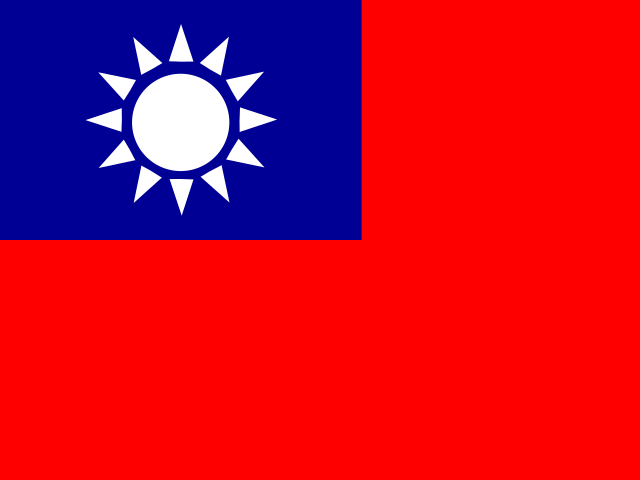
Chinese Taipei
The Taiwanese government enacted in the late 2010s the Statute for Renewable Energy Development to reduce CO2 emissions, improve energy diversification and promote green-energy industries. The government is seeking to generate 8% of electricity from renewables by 2025.
- Overview
- Energy mix
- Emissions
- Electricity
-
+ 5 pages

![Chinese Taipei Flag]()
-
Coal Mid-Year Update 2025 Trade
…growth in imports, with coal imports reaching new highs. Imports increased by 14% up to 548 Mt, resulting in total annual imports surpassing 500 Mt for the first time. This volume is more than double that of India, the second-largest importer. Viet Nam also emerged as a key importer in 2024, surpassing Chinese Taipei to join the top five. Imports into Viet Nam are estimated to have increased by 16%, supported by strong demand and stable domestic production. In 2024, Indonesia’s thermal coal exports grew by 6%, reaching 549 Mt, largely driven by strong demand from China. Australia also…

-
Coal 2025 Trade
…1 111 Mt, while met coal trade is expected to contract by 3% to 357 Mt. This shift is primarily driven by China, where abundant stocks and sluggish demand have driven its imports down by around 58 Mt to 489 Mt. Similarly, in India domestic thermal coal production is flat while demand is weak, keeping imports at around 235 Mt. Chinese Taipei, Korea and Japan, with negligible domestic production, are also expected to reduce coal imports in 2025. Meanwhile, the European Union is expected to maintain their coal import levels at 70 Mt, effectively pausing the structural decline seen in recent years.Mirroring trends in importing countries, Indonesia…
- Executive summary
- Demand
- Supply
- Trade
-
+ 2 pages

-
Chinese Taipei coal phase out plan
The plan aims at decommissioning the Taichung Power Plant in two phases: Phase I (2025-26): Coal-fired units 1 and 2 are dismantled, coal-fired units 3 and 4 are decommissioned and converted into backup units, and the first two gas-fired units become operational.Phase II (2031-34): Coal-fired units 3 to 10 are dismantled, and a third and fourth gas-fired unit becomes operational.
-
Chinese Taipei-Panama Free Trade Agreement
The Free Trade Agreement between Chinese Taipei and Panama entered into force in 2004, providing for preferential import tariffs for most products traded between them, notably iron and steel, minerals, hydrocarbons, nuclear reactors, quartz reactors, semiconductors, automotive parts etc. Rule of origins apply to qualify for preferential tariff treatment : products should be wholly obtained, produced or have undergone a sufficient production process in the territory of the signatories, or satisfy a 55% minimum local value content requirement.
-
Chinese Taipei- New Zealand Agreement on Economic Cooperation
The Agreement between New Zealand and Chinese Taipei entered into force in 2013. It provides for the gradual elimination of border tariffs by 2025, including for minerals, hydrocarbons, metals, reactors, semiconductors and automobile parts.Rules of origin delineated in the Agreement provide that preferential tariff treatment may be granted to products wholly obtained or having undergone a sufficient production process in one of the signatories countries.The Agreement is to be reviewed within two years of entry into force and every three years thereafter.
-
Agreement between Singapore and Chinese Taipei
Chinese Taipei and Singapore entered into a free trade agreement in 2014 which provides for the elimination of border tariffs, for most energy products, including: Electric motors, turbines and generators; Mechanical equipment including pumps, appliances, and other advanced machinery; Electric accumulators, transformers, capacitors, batteries; Motor vehicles; Mineral ore, slag and ash; Mineral fuels, oils and other products; Metals and their articles e.g. iron and steel; Semiconductors devices and photovoltaic cells; Rule of origins apply to qualify for the preferential tariff treatment, which is granted for goods wholly obtained, entirely produced or having undergone sufficient production processes in the territory…
-
Chinese Taipei-Paraguay Economic Cooperation Agreement
The Chinese Taipei-Paraguay Economic Cooperation Agreement entered into force in 2018. Under the Agreement, Paraguay offers preferential tariff for iron & steel, automotive parts and pumps.Rule of origins delineated in the Agreement state that in order to qualify for the preferential tariff treatment, good should be wholly obtained, produced or have undergone sufficient production in the territory of the signatories, or satisfy a minimum local value content of 55%.
-
Chinese Taipei- Guatemala Free Trade Agreement
The Free Trade Agreement between Chinese Taipei and Guatamala entered into force in 2006. It provides for preferential border tariffs for most products traded between them, including iron and steel, minerals, hydrocarbons, machinery, reactors, semiconductor, and automotive parts.Rule of origins delineated in the Agreement state that to qualify for the preferential tariff treatment, good should be wholly obtained or have undergone a sufficient production process in the territory of the signatories, or satisfy a 35-50%minimum local value content requirement.
-
El Salvador - Honduras - Chinese Taipei Free Trade Agreement
The Free Trade Agreement between Honduras, El Salvador and Chinese Taipei entered into force in July 2008, providing for border tariff reduction or elimination, including for: Electric motors, turbines and generators; Mechanical equipment including pumps, appliances, and other advanced machinery; Electric accumulators, transformers, capacitors, batteries; Motor vehicles; Mineral ore, slag and ash; Mineral fuels, oils and other products; Metals and their articles e.g. iron and steel; Semiconductors devices and photovoltaic cells;