-
Mali
In recent years, the rate of access to electricity in Mali has surpassed 25%, thanks to a public focus on mini-grid solutions. The government of Mali now plans to increase hybridisation of its mini-grids by adding PV capacity to diesel power plants. In 2019, Mali’s energy mix was dominated by biofuels and wastes (65%) and oil products (32%), with coal and hydro accounting for the rest. In 2020, less than 5% of the population had access to clean cooking and 52% had access to electricity. For electricity access, the country targets 70% access by 2025, 80% by…
- Overview
- Energy mix
- Emissions
- Electricity
-
+ 5 pages

![Mali Flag]()
-
Roadmap for the growth and development of Nigerian mining industry
To diversify economic activity and export composition, the government launched the Roadmap for Solid Minerals in 2016 with the purpose of increasing mining’s contribution to GDP to 10% by 2026. The plan is divided into three phases: rebuilding the market confidence and win over domestic users of imported industrial minerals; focussing on expanding domestic processing industry; and seeking to return to global markets and a market competitive price point.Even though not all of them are a direct result of the policy, currently, there are various incentives for the investment in the mining sector. One is the Tax Holiday…
-
Honduras
In 2014, Honduras approved a new Law of Electrical Industry, which establishes technology-specific auctions for renewable energy. 75% of the population has access to electricity in the country and only 48% can rely on clean cooking facilities.
- Overview
- Energy mix
- Emissions
- Electricity
-
+ 5 pages

![Honduras Flag]()
-
Rwanda
Rwanda included strong commitments to its intended nationally determined contribution (INDC) to the Paris Agreement. The country plans to increase its carbon sink capacity through sustainable forest management practices and to reduce emissions from the agricultural sector. In 2019, Rwanda’s energy mix was dominated by biomass and waste (74%) and oil products (20%), while natural gas, coal and hydro account for the rest of the energy supply. In 2020, less than 5% of the population had access to clean cooking and 50% had access to electricity. With annual access growth of more than 3 percentage points, Rwanda has shown…
- Overview
- Energy mix
- Emissions
- Electricity
-
+ 5 pages
![Rwanda Flag]()
-
Universal Access to Clean Cooking in Africa
Progress update and roadmap for implementation Clean cooking access is a defining challenge for Africa’s prosperity. While the number of people without access to clean cooking has halved globally since 2010, the number in sub-Saharan Africa continues to rise. This harms health, economic development, and the environment – contributing to 815 000 premature deaths annually and significant deforestation.In a new report, Universal Access to Clean Cooking in Africa: Progress update and roadmap to implementation, the International Energy Agency (IEA) provides an updated picture of where things stand today, where efforts are gaining ground, and where urgent action is…

-
Libya
In 2013, the Libyan government launched the Renewable Energy Strategic 2013-2025 Plan, which aims to achieve 7% renewable energy contribution to the electric energy mix by 2020 and 10% by 2025. This will come from wind, Concentrated Solar Power, solar PV and solar heat.
- Overview
- Energy mix
- Emissions
- Electricity
-
+ 5 pages
![Libya Flag]()
-
Kenya 2024
Energy Policy Review Government action is pivotal in building secure, inclusive and sustainable energy systems. Energy policy is critical not just for the energy sector but also for meeting environmental, economic and social goals. Governments need to respond to national specific needs, adapt to regional contexts, and help address global challenges. In this context, the International Energy Agency (IEA) conducts Energy Policy Reviews to support governments in developing more impactful energy and climate policies.This Energy Policy Review of Kenya was prepared in collaboration between the government of Kenya and the IEA, whose strong partnership achieved an important milestone in…

-
Iraq
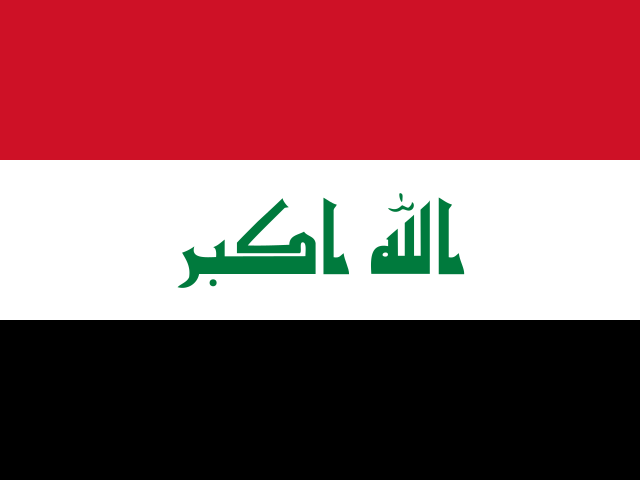
Iraq holds abundant oil and gas resources and has strong solar PV potential. Its production to 2030 is set to be third largest contributor to global oil supply. By the same year, the government expects that renewable capacity will amount for 5% of the country’s total system capacity.
- Overview
- Energy mix
- Emissions
- Electricity
-
+ 5 pages

![Iraq Flag]()
-
Nationally Determined Contribution (NDC) to the Paris Agreement: Nigeria
…47 percent, with 20 percent of emissions unconditional. The updated ambition includes improved reduction projections for the waste sector and new gases, including short lived climate pollutants (SLCPs) and hydrofluorocarbons (HFCs). With this revised baseline, Nigeria’s updated NDC results in far fewer absolute emissions than were previously submitted in the 2015 NDC—more ambitious as a percentage, consistent with the 1.5°C pathway, and peaking emissions by the end of the decade. With respect to oil and gas emissions, the revised NDC is significantly stronger than the prior NDC. The revised NDC commits to end flaring by 2030, whereas…
-
Environmental Guidelines and Standards for the Petroleum Industry In Nigeria (EGASPIN)
Outlines the requirements for environmental management and pollution abatement at all stages of the petroleum production process. Requires the submissions of environmental impact assessment to the Department of Petroleum Resources before the granting of a license. Revised in 2002. Part III (Production), Sec. 3.8.8.1 prohibits gas flaring, then states if flaring must occur, operators must secure a waiver and permit to flare gas; they must pay the necessary fines for every standard cubic meter flared; they must pre-treat the gas; create a setback of 60 m radius for the flare; ensure complete combustion; close system valves…