-
An Energy Sector Roadmap to Net Zero Emissions in Colombia Executive summary
Colombia is one of the region’s growth success stories Colombia is the third-largest country in Latin America and the Caribbean (LAC) by population, with 53 million inhabitants. Its economy has grown steadily since 1971, even during the “lost decade” experienced by LAC in the 1980s, and with very few exceptions during global crises. GDP has increased by an annual average of 2.4% since 2015, outpacing the regional average of 1.2%. This growth has been accompanied by tangible improvements in indicators of living standards for Colombia’s population: access to clean cooking and electricity have significantly improved, both standing…

-
Energy Efficiency Policy Toolkit Energy Efficiency Policy Toolkit: Case studies
The following case studies demonstrate how different countries have successfully implemented energy efficiency policies across various sectors. These real-world examples are designed to support policymakers by offering practical insights into what works, under which conditions, and why.Each case study highlights specific policy instruments—such as regulations, information campaigns, or financial incentives—and shows how they have been applied in different contexts. They provide evidence on the outcomes achieved, lessons learned, and the challenges encountered during implementation. Readers are encouraged to explore the case studies by sector, policy type, or geographic region using the filters provided. Case studies bridge…

-
Financing Clean Energy in Africa Executive summary
A dramatic increase in energy investment into African countries is essential Multiple recent crises have made it increasingly challenging for many African countries to raise financing to support their clean energy ambitions, despite the continent’s huge needs and rich and varied resources. Africa accounts for around 20% of the world’s population but attracts less than 2% of its spending on clean energy. In recent years, African countries have had to deal with a series of overlapping crises, including the Covid-19 pandemic, the energy and food crises following Russia’s invasion of Ukraine and worsening climate risks. Borrowing…

-
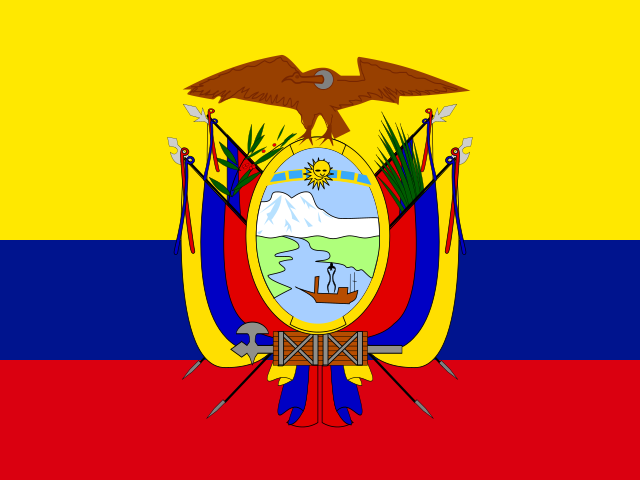
Ecuador
In Ecuador, The Energy Efficiency National Plan 2016-2035 presents an inter-sectoral plan for energy efficiency, policies in transport, industry, residence, production, generation and all energy consumption sectors. In 2013, a new feed-in tariff scheme for renewable energy projects also entered into force.
- Overview
- Energy mix
- Emissions
- Electricity
-
+ 5 pages

![Ecuador Flag]()
-
Argentina
…7%) and solar (1%). A set of public policies have boosted utility-scale projects in variable renewables, taking advantage of its rich solar and wind resources. The country has set a goal for non-hydro renewables to reach 20% of the power mix by 2025 and recent efforts have triggered increased deployment (2021: 12.5%).
Argentina is the world’s fourth largest lithium producer, a mineral critical for the manufacture of battery storage systems and, therefore, for the energy transition. Argentina is among the first Latin American countries to achieve universal electricity access, with a successful programme on rural electricity…- Overview
- Energy mix
- Emissions
- Electricity
-
+ 5 pages
![Argentina Flag]()
-
Montenegro
The Energy Development Strategy of Montenegro sets out objectives and defines mechanisms for the transition from the current energy system to a safe, competitive and environmentally acceptable energy paradigm by 2025. It also provides guidelines for the development of the energy sector with the aim of attracting investors.
Data for Montenegro is included under Serbia until 2004.- Overview
- Energy mix
- Emissions
- Electricity
-
+ 5 pages

![Montenegro Flag]()
-
Renewables 2021 Renewable electricity
Forecast summary Renewable capacity additions are set to grow faster than ever in the next five years, but the expansion trend is not on track to meet the IEA Net Zero by 2050 Scenario Annual additions to global renewable electricity capacity are expected to average around 305 GW per year between 2021 and 2026 in the IEA main case forecast. This implies an acceleration of almost 60% compared to renewables’ expansion over the last five years. Continuous policy support in more than 130 countries, ambitious net zero goals announced by nations accounting for almost 90% of global GDP, and improving competitiveness…

-
World Energy Investment 2026 How we track investment in energy
Tracking energy investment The way investment is measured across the energy spectrum varies, largely because of differences in the availability of data and the nature of expenditures. This document highlights the methodology used to ensure that the estimates are consistent and comparable across sectors in the World Energy Investment 2026 (WEI 2026) report and other publications from the International Energy Agency. The IEA measures investment as the ongoing capital spending on assets. For some sectors, such as power generation, this investment is spread out evenly from the year in which a new plant or upgrade of an existing one takes…

-
Cambodia
Cambodia’s electrification rate is the second-lowest among South East Asian countries. Cambodia plans to increase its power generation capacity by building hydropower and coal-fired plants by 2025, which can contribute to improve self-sufficiency of power supply.
- Overview
- Energy mix
- Emissions
- Electricity
-
+ 5 pages

![Cambodia Flag]()
-
China’s Official Energy Finance in Emerging and Developing Economies Case 1. Uzbekistan 1-GW Solar PV Project
…groups. Historically known for large thermal and hydropower EPC projects, the company has, over the past decade, shifted towards an integrated “EPC + own + operate” model, particularly for renewables. This strategic shift aligns with China’s dual-carbon goals, its pledge to stop building new coal plants overseas and the growing demand for invest-and-operate models in EMDE markets. In February 2023, CEEC signed a memorandum of understanding with the Uzbekistan Energy Ministry and committed to developing a total of 2-GW of solar power in Uzbekistan. As part of its commitment, a 1-GW solar photovoltaic (PV) complex project…