Cite report
IEA (2026), Energy Technology Perspectives 2026, IEA, Paris https://www.iea.org/reports/energy-technology-perspectives-2026, Licence: CC BY 4.0
Report options
Executive summary
Despite headwinds, the markets for clean energy technologies and fuels are expanding rapidly
Deployment of many clean energy technologies, fuels and materials has been growing fast, but shifting policies, economic conditions and technological progress are creating uncertainty about their prospects and economic potential. Against this backdrop, the IEA’s flagship technology publication Energy Technology Perspectives (ETP) aims to separate the signal from the noise, by providing timely data, scenarios and analysis across deployment, manufacturing, trade, competitiveness and security. At a time when misjudging the moment risks wasting capital or stalling momentum, this report has been designed to help decision makers navigate uncertainties.
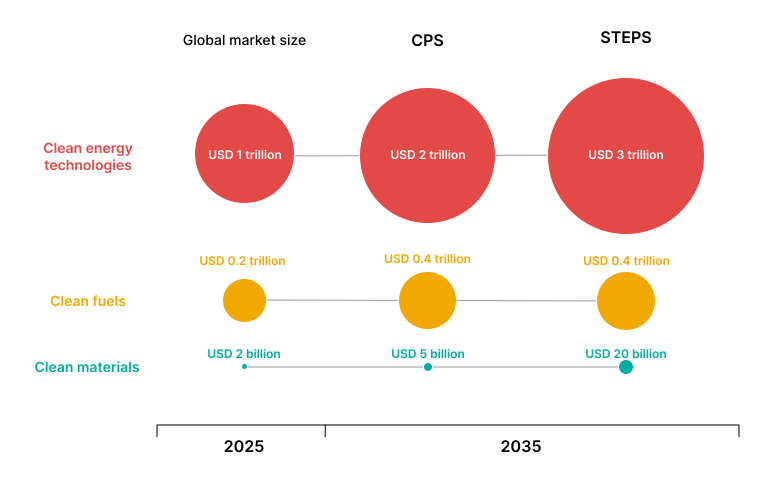
Deployment of clean energy technologies rises in all IEA scenarios1, but the extent to which the market value grows will depend on policy direction. The combined global market value for clean energy technologies has grown 20% on average per year over the past decade, to reach nearly USD 1.2 trillion in 2025. In the Current Policies Scenario (CPS), their global market value grows most slowly, but it still doubles to around USD 2 trillion in 2035, about the size of the global crude oil market in 2025. At almost USD 3 trillion by 2035, their market value is higher in the Stated Policies Scenario (STEPS), with greater deployment offsetting the additional decline in costs. Electric cars are by far the largest clean energy technology market in 2035, accounting for around three-quarters of the total market value in all scenarios.
There are many growth opportunities for low-emissions fuels, especially those that can be directly used in existing infrastructure. In several segments – notably cars – low-emissions fuels are not only competing with fossil fuels, but increasingly with the rising use of electricity. However, the medium-term growth prospects remain bright: their market value grows significantly in both the CPS and the STEPS, from around USD 215 billion in 2025 to about USD 390 billion in 2035, equivalent to about 20% of the combined market for diesel and gasoline used in transport. Around 60% of this growth comes from the expansion of relatively mature biofuels such as biomethane, bioethanol and biodiesel. Increased use of fuels that are more costly and still at low levels of market penetration, such as sustainable aviation fuels and other hydrogen-based fuels, would require stronger policy support.
The market outlook for low- and near-zero emissions materials is very uncertain as production cost premiums remain high. Technologies like cement kilns fitted with carbon capture, and steel furnaces using electrolytic hydrogen, are expected to cost significantly more than their conventional counterparts over the next decade in most regions. The outlook for near-zero emissions materials is therefore highly dependent on policy support: the market value for near-zero emissions steel, cement, aluminium and ammonia reaches USD 5 billion in the CPS and USD 20 billion in the STEPS in 2035.
The market value of clean energy technologies grows in all scenarios
Market value of clean energy technologies, low-emissions fuels and near zero emissions materials by scenario
Open
There is measurable progress across energy technologies that are at different stages of development today
The positive market outlook for clean energy technologies that underpin the age of electricity has been led by policy but is increasingly driven by cost-competitiveness. Cost reductions for many technologies like solar PV, batteries, electric cars or heat pumps have been enabled by their modularity and mass-manufacturing, while for others, like nuclear or geothermal, technology innovation has been a key driver. Around 80% of global solar PV and wind generation now occurs at lower levelised costs than for coal or gas, supporting a surge in global capacity additions. Battery prices have fallen by 75% over the past decade, boosting electric car sales and enabling a larger share of variable renewable energy in electricity supply. In some emerging markets, battery electric cars are becoming cheaper to buy than comparable internal combustion engine cars. The future pace of deployment of these technologies hinges on policy support to foster markets and overcome infrastructure bottlenecks.
There is evidence of progress – albeit less steady – for technologies at an early stage of deployment, and this is moving faster than many people think. Low-emissions hydrogen production; carbon capture utilisation and storage (CCUS); and near-zero emissions material production typically involve large engineering projects that rely on policy support to scale up and reduce costs. Earlier high investor confidence and policy ambition has weakened recently, but growth opportunities exist. Global investment in low-emissions hydrogen production climbed to nearly USD 8 billion in 2025 – year-on-year growth of 80% – and expected growth in electrolyser deployment to 2030 is similar to the expansion seen as solar PV began to ramp up. For CCUS, average annual investment has grown more than 15-fold since 2020 to over USD 5 billion in 2025, with several landmark projects reaching final investment decisions (FIDs), though almost 90% of announced projects have not yet reached that milestone. Since 2020, new capacity for near-zero emissions steel production announced (105 Mt, around 5% of today’s production) has been roughly double the conventional capacity added, but only 5% has reached FID.
Technologies at early stages of development, or with applications beyond energy, are capturing widespread attention, but their real-world viability and impact is yet to be proven. Start-ups developing technologies such as nuclear fusion, solid-state cooling, iron ore electrolysis, production of conventional cement without limestone or direct electrochemical ammonia production are now attracting increased investments. But they are still at early stages of technology readiness and face substantial technical and cost barriers. It is unlikely that they will reach significant market shares within a decade; if successful, however, they could trigger profound transformations, and these market shares could be worth trillions of dollars by mid-century. Several technical records for nuclear fusion were broken in 2025, and venture capital has flowed into the sector, but the timeline for commercialisation and technology costs remain deeply uncertain. Falling computation costs, more data and technical breakthroughs have driven AI capabilities to accelerate energy innovation, but the extent of its real-world impact remains to be seen.
Energy technology manufacturing and trade are showing signs of resilience to changes in industrial and trade policy
Many governments are adopting an increasingly defensive posture on clean energy technology trade, seeking to shield domestic industries from foreign competition and alleged unfair practices. Early evidence of the impact of tariff hikes in 2025 points to a flurry of short-term adjustments by manufacturers, including front-loaded shipments, deferred investments, precautionary stockpiles and a slowdown in some trade flows. However, of all global gross imports of clean energy technologies in 2025, only about 15% was accounted for by countries that now impose substantially higher tariffs. While tariff and duty increases are expected to put upwards pressure on average production and import costs, the impact in 2025 was, in many cases, partly balanced out by falling commodity prices, the substitution of imports with financially supported domestic production, and other alterations to trade patterns. Moreover, the impact of tariffs and duties on final consumer costs depends on the product: the same tariff levied on a final product like an electric vehicle has a greater impact than the same tariff applied to a system component, like solar PV modules, which typically account for around 10-15% of the consumer cost of a domestic rooftop solar installation in many advanced economies.
Trade of key clean energy technologies hit an all-time high in Q2 2025
Trade continues to play a central role in the outlook for manufacturing key clean energy technologies, despite recent increases in tariffs. In the STEPS, the global value of net trade in these technologies more than doubles from USD 290 billion in 2025 to reach USD 620 billion by 2035. China remains the largest exporter by a wide margin, with the value of its net exports growing to USD 375 billion in 2035 – the latter figure is equivalent to around 10% of the country’s total goods exports today. The projected rate of increase in the value of global trade is broadly in line with what was projected in ETP-2024, as trade policies are only one of many forces shaping clean energy technology supply chains; industrial and energy policies also play a role.
Trade remains an important feature of technology supply chains
Continued industrial and trade policy responses to China’s growing EV exports – worth an estimated USD 50 billion in 2025 – have increasingly re-routed them to new markets. While emerging economies accounted for less than 5% of China’s EV exports in 2020, they now represent nearly 40%. In Central and South American countries, Chinese EVs are projected to make up around half of total EV sales on average in the STEPS by 2035. In the European Union, maintaining existing countervailing duties helps prevent the share of Chinese imports in the region’s EV sales from increasing significantly above today’s level of around 20% through to 2035. Nevertheless, given the size of the market, the region becomes the largest source of growth for China’s EV exports in absolute terms. China remains the world’s largest EV exporter in the STEPS to 2035, as exports grow almost sixfold. The North American market remains virtually closed to Chinese EV imports in this scenario.
China’s clean technology manufacturing drives global markets
Industrial and trade policies introduced in the United States and India are boosting downstream stages of solar PV manufacturing domestically, though China remains the largest producer across all supply chain steps. India experiences the largest increase in share of global production in the STEPS, rising from 3% in 2024 to more than 10% by 2035, and becomes a net exporter of modules by 2030. Existing policies and a decline in demand in the United States lead to near self-sufficiency by 2030 in the STEPS. In the European Union, the Net-Zero Industry Act has moved to the implementation phase, but the targets it sets are not accompanied by systematic financial support for domestic investment. This is reflected in the limited announcements for new solar PV manufacturing facilities and the targets not being met in the STEPS.
Concentration in clean energy technology supply chains remains a source of vulnerability
New analysis shows that production outside the largest exporter of clean energy technologies could, in principle, meet most demand in those countries on aggregate, but there are weak links within each supply chain. Each of the key supply chains analysed contains at least one step where less than one-quarter of demand outside of China could be met with supply outside of China, posing risks to the resilience of the entire supply chain. China’s manufacturing strengths mean the country accounts for 60-85% of production capacity for key supply chains, and over 95% for some production steps. The economic impact of a disruption would differ for each supply chain and technology. For example, each month of a halt in battery supply chain exports from China would lead to an estimated loss in output of USD 17 billion from electric car factories elsewhere, with facilities in the European Union accounting for over half of the losses. Each month of disruption of Chinese exports of solar supply chain components would mean that solar PV module production plants outside China lose output worth around USD 1 billion, with more than 40% of the affected output located in Southeast Asia and India.
For several steps in the battery supply chain, less than one-quarter of global demand could be met by suppliers outside China.
Availability of production along battery supply chains relative to demand outside China, 2024
OpenSupply chain concentration is especially acute for metal and mineral processing, and midstream production steps. Metals and mineral processing capacity outside China is adequate for materials like steel and copper, but far from sufficient for most critical minerals. Magnet rare earth elements – used in wind turbines and electric cars as well as multiple other technologies from drones to data centres – are particularly affected, as refining is dominated by China; the vulnerabilities associated with such dependencies were brought into sharp focus when China recently announced export restrictions on these elements. On the basis of committed manufacturing and mining projects, and projected market trends in the STEPS, no major change in the diversity of clean energy technology supply chains is likely to occur before 2030.
The impact of Chinese clean energy technology manufacturing companies extends beyond the country’s borders. Chinese firms account for a large portion of production capacity located outside China in the solar PV industry. In contrast, Chinese ownership of battery manufacturing capacity outside China remains limited (5%) but is expected to rise to around one-quarter by 2030 based on projects in construction or at FID. Dependencies in the supply chain extend to IT systems; increased digitalisation brings exposure to new, evolving cybersecurity risks that can affect energy technologies’ control systems, and with them entire distribution grids.
China plays an outsized role in clean energy technology supply chains
Shares in global production of clean energy technologies, 2024
OpenThe present wave of clean energy technology manufacturing investment is waning – the future trajectory of investment will be shaped by efforts to diversify supply chains. Global manufacturing investment for key clean energy technologies fell back slightly to just under USD 200 billion in 2024 from a high of USD 220 billion in 2023, and it is expected to have continued to decline gently through to year-end 2025. Manufacturing investment for most technologies does not return to the levels reached over the past 2 years in the STEPS and CPS through to 2035. This is largely due to a surplus of existing manufacturing capacity relative to current demand for solar PV and batteries, and because increased investment to meet future demand for EVs is offset by reduced investment for other technologies. Continued manufacturing investment in the STEPS is, in large part, driven by efforts to diversify supply chains: for example, the combined share of the European Union and the United States in global clean technology manufacturing investment increases from less than 25% in 2024 to more than 35% on average during 2031-2035.
Clean technology manufacturing facilities are numerous, but overall capacity is geographically concentrated
If not addressed, industrial competitiveness could become a stumbling block for energy and economic policy goals
In clean energy technology manufacturing, the factors shaping industrial competitiveness differ across supply chains. China’s competitive edge and low costs reflect decades of accumulated advantages, including innovation, largescale production, manufacturing efficiency, a skilled workforce, integrated supply chains and access to cheap resources and labour – all reinforced by consistent policy and financial support. Across all supply chains considered, there are opportunities to reduce the cost gap with China as experience ramps up in other countries, and through continued innovation. For batteries, higher manufacturing efficiency accounts for over 40% of the cost difference between China and Europe. Energy and labour cost differences account for a large share of the cost gap with Europe in energy and labour-intensive steps, such as upstream solar PV manufacturing (65% of the gap) and in wind blade production (75%). Electrolyser manufacturing is not yet established at scale anywhere, and there is a trade-off between low-cost production, efficiency and durability, meaning that production in advanced economies can still be competitive.
There is no single recipe for bridging the competitiveness gap with China.
Difference in production cost between the European Union and China for selected clean energy technologies by contributing factor, 2024
OpenIn upstream industries like steel, aluminium and chemicals, energy costs remain critical to competitiveness in near-zero emissions material production. Energy costs can account for over two-thirds of total production costs in upstream industries; for near-zero emissions technologies, energy spending could be several times higher. The impacts are profound: During the 2022 global energy crisis, for example, output from upstream industries in the European Union fell sharply. In contrast, since the early 2020s, access to cheap shale gas in the United States has significantly increased its share of global petrochemical feedstock and product exports. Low-cost renewables could make hydrogen-based steelmaking cost-competitive with conventional technologies in the future under specific conditions in some major steel-producing countries like the United States, China and India. In others, like Europe and Japan, higher prices mean production costs would remain 50-80% higher than elsewhere, surpassing regional differences for conventional steel production. Yet offshoring ironmaking to regions with competitive renewables could cut these cost differences to 30-40%, with limited effects on jobs.
To rise to the moment, countries will need to identify and play to their strengths and look to strategic partnerships to increase industrial competitiveness. While downstream industries typically generate more direct value added to the economy, strategic upstream industries are a source of indirect value creation, and are crucial to multiple sectors beyond energy, including defence. There is a balance to be struck between domestic production and imports of technologies and materials; the way this balance plays out depends on the relative strategic importance of these industries. Some emerging markets with particularly low energy costs – such as in the Middle East or North Africa – could achieve production costs even lower than China’s for energy-intensive processes. Producing solar PV modules made in the European Union with imported wafers from North Africa could cost almost 20% less than producing a fully EU-made module. India, Southeast Asia and the Middle East could, in principle, produce polysilicon and wafers at comparable costs to China, and Southeast Asia already has production capacity in place for these commodities. For wind turbines, producing in Europe while importing components from India could cost only 15% more than producing turbines in China, cutting 75% of the production cost gap between Europe and China. Strategic co-operation between countries for specific supply chain steps can reduce costs and increase diversification.
International collaboration helps diversification & competitiveness
References
ETP-2026 uses three main scenarios, consistent with those presented in the World Energy Outlook 2025. The CPS and the STEPS are exploratory and based on a set of starting conditions. The NZE Scenario is normative and describes a pathway to reduce global energy sector CO2 emissions to net zero by 2050, while recognising that each country will follow its own route.
Reference 1
ETP-2026 uses three main scenarios, consistent with those presented in the World Energy Outlook 2025. The CPS and the STEPS are exploratory and based on a set of starting conditions. The NZE Scenario is normative and describes a pathway to reduce global energy sector CO2 emissions to net zero by 2050, while recognising that each country will follow its own route.