-
Electricity Mid-Year Update 2025
Despite a slowdown in global economic growth prospects, the world’s electricity consumption increased strongly in the first half of 2025, driven by rising demand from industry, appliances, cooling, data centres and electrification. At the same time, electricity supply from renewables, natural gas and nuclear continues to grow, with all set to reach new milestones.This mid-year update follows the extensive Electricity 2025 report released in February, examining the latest trends and the outlook for the remainder of the year. It includes updated data for 2024 along with new forecasts for 2025 and 2026 covering areas such as global…

-
Access and Affordability
“An Affordable and Sustainable Energy System for Sub-Saharan Africa” (Energy Sub-Saharan Africa) is a five-year programme (2019-2024) funded by the European Union. It supports work with Benin, the Democratic Republic of the Congo, Ethiopia, Ghana, Kenya, Nigeria, Rwanda, Senegal, Uganda and Zambia, with the aim of promoting sustainable and inclusive economic growth through the transition towards a low-carbon and climate-resilient energy sector, while delivering universal and affordable energy access to all. Today, 730 million people around the world live without access to electricity, while over 2 billion people continue to rely on harmful cooking fuels…
-
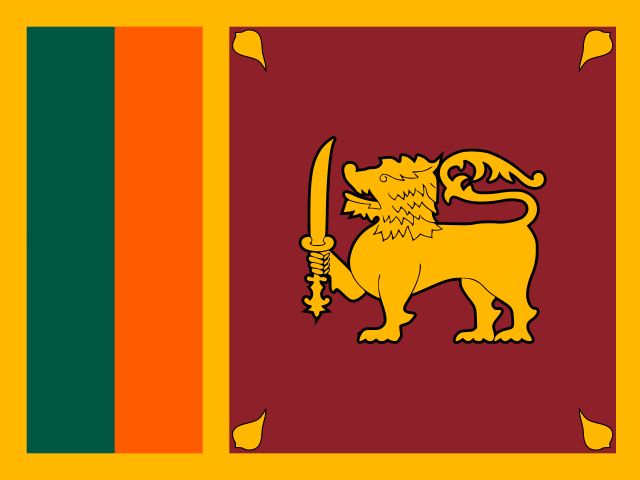
Sri Lanka
Sri Lanka’s primary energy supply mainly comes from oil and coal. Almost 40% of Sri Lanka’s electricity came from hydropower in 2017 but coal’s shares in power generation has been increasing since 2010. Sri Lanka is reaching universal access to electricity but clean cooking remain an issue with 15 million people still relying on biomass to cook.
- Overview
- Energy mix
- Emissions
- Electricity
-
+ 5 pages

![Sri Lanka Flag]()
-
Gaining an Edge Opportunities in efficiency markets
As market demand grows, the manufacturing of energy efficiency technologies represents a new opportunity Facing volatile energy prices, rising energy security risks and stricter regulations, all sectors are turning to energy efficiency technologies to reduce consumption and manage these growing challenges. At the same time, governments around the world committed at COP28 in Dubai in 2023 to work collectively to double the global average annual rate of energy efficiency improvements.These dynamics have triggered a strong increase in demand for energy efficiency technologies. For example, the market for electric vehicles (EVs) and batteries has grown nearly six-fold from 2020…

-
World Energy Investment 2026
World Energy Investment is the global benchmark for tracking investment trends across the energy sector. The report will present the latest data on capital flows to different types of energy projects, as well as the first set of full-year estimates for 2026.As energy security concerns continue to shape investment priorities, this year’s report will explore the potential implications for different sectors and regions, particularly in light of the ongoing energy crisis stemming from the conflict in the Middle East.The 2026 edition will highlight major investment milestones and opportunities from different energy sectors and regions. It also includes…

-
Estonia
Estonia has achieved a notable reduction in greenhouse gas emissions thanks mainly to lowering its reliance on electricity generation from domestic oil shale, an energy rich sedimentary rock. However, oil shale remains the main energy source and imported fossil fuels still plan a major role, especially in transport. Estonia’s forests, which historically offset significant greenhouse gas emissions, have become a net emissions source. Estonia is aiming to accelerate its clean energy transition with a target to cover 100% of annual electricity demand with renewables by 2030 as part of a larger package to achieve climate neutrality by 2050. It…
- Overview
- Energy mix
- Emissions
- Electricity
-
+ 5 pages

![Estonia Flag]()
-
Ukraine
Ukraine is a key country for European and global energy security. Russia’s invasion of Ukraine has pushed it to fundamentally reshape its past dependence on energy imports from Russia.
As the invasion continues, Ukraine is focused on tracking large-scale energy supply disruptions and actively working to recover power and heating for civilians. It is also putting together an ambitious recovery and reconstruction plan, with a strong focus on energy security. In the medium-term, Ukraine’s energy strategy remains focused on European integration, while it aims to an energy system that is ready for a Net Zero future…- Overview
- Energy mix
- Emissions
- Electricity
-
+ 5 pages
![Ukraine Flag]()
-
Unlocking Ukraine’s Hydrogen Opportunity: A Roadmap
Ukraine’s energy sector has been severely affected by the Russian Federation’s full-scale invasion. The power sector went from having a large capacity surplus before the war to a power deficit in 2024 due to Russia’s attacks. This has focused attention on energy security and restoring the reliability of supply. Hydrogen demand from conventional applications in refining and ammonia has also plunged, falling 80%, with most of these assets in southern Ukraine, where the frontline and occupied areas are located. Overall economic damage from the war has been extensive, with reconstruction costs previously estimated by the World…

-
Multiple Benefits of Energy Efficiency for Business Operational benefits
For every dollar in energy cost savings, productivity gains can deliver up to an extra 30 cents of value Energy efficiency measures can improve how firms use labour, equipment and materials, leading to gains that go beyond reduced energy use. These improvements are often driven by more efficient, precise and optimised processes. By reducing losses – such as excess heat, inefficient combustion or friction – equipment operates more smoothly and reliably. Electrified processes can further enhance efficiency by reducing the number of moving parts and points of failure.This improved performance leads directly to higher productivity. More efficient production lines enable better…

-
Rwanda
Rwanda included strong commitments to its intended nationally determined contribution (INDC) to the Paris Agreement. The country plans to increase its carbon sink capacity through sustainable forest management practices and to reduce emissions from the agricultural sector. In 2019, Rwanda’s energy mix was dominated by biomass and waste (74%) and oil products (20%), while natural gas, coal and hydro account for the rest of the energy supply. In 2020, less than 5% of the population had access to clean cooking and 50% had access to electricity. With annual access growth of more than 3 percentage points, Rwanda has shown…
- Overview
- Energy mix
- Emissions
- Electricity
-
+ 5 pages

![Rwanda Flag]()