-
Global Energy Review 2025 Key findings
Global energy demand grew by 2.2% in 2024 – faster than the average rate over the past decade. Demand for all fuels and technologies expanded in 2024. The increase was led by the power sector as electricity demand surged by 4.3%, well above the 3.2% growth in global GDP, driven by record temperatures, electrification and digitalisation. Renewables accounted for the largest share of the growth in global energy supply (38%), followed by natural gas (28%), coal (15%), oil (11%) and nuclear (8%).Emerging and developing economies accounted for over 80% of global energy demand growth. In China, growth…
- Key findings
- Global trends
- Oil
- Natural gas
-
+ 3 pages

-
Oil Market Report - June 2026
The IEA Oil Market Report (OMR) is one of the world's most authoritative and timely sources of data, forecasts and analysis on the global oil market – including detailed statistics and commentary on oil supply, demand, inventories, prices and refining activity, as well as oil trade for IEA and selected non-IEA countries. Highlights Global oil demand is forecast to decline by 1.1 mb/d y-o-y in 2026. This represents a downgrade of 700 kb/d compared with our May Report, as 2Q26 deliveries plunged by 5 mb/d y-o-y in the face of higher…

-
Policy options to accelerate distributed solar PV in Ukraine Policy options and implications
Overview of policy instruments for distributed solar PV deployment Globally, government policies and incentives have been the main driver for distributed PV deployment. These instruments can be differentiated between 1) policies targeting investment costs and 2) policies focusing on consumption and the sale of electricity.Policies targeting investment costs usually take the form of direct financial incentives that aim to reduce initial investment costs and make distributed PV systems more affordable for consumers. They include:Grants and rebates: a fixed subsidy, usually with a one-time payment.Tax credits: amounts taxpayers can subtract from taxes, usually based on a percentage…

-
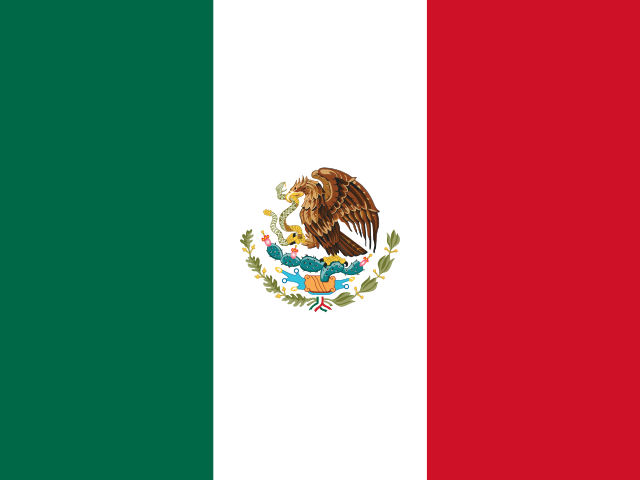
Mexico
Mexico’s energy and economic profile presents both challenges and opportunities as a major oil producer, exporter and through its growing domestic energy demand. Mexico was the first large oil producing emerging economy to adopt climate legislation in 2012 and has seen growth in renewable electricity generation from wind and solar, which almost tripled from 2015 to 2022. However, strong action is needed across all sectors to reduce reliance on fossil fuels and bring down greenhouse gas emissions.
- Overview
- Energy mix
- Emissions
- Electricity
-
+ 5 pages

![Mexico Flag]()
-
Austria 2026
Energy Policy Review Government action plays a pivotal role in ensuring secure and sustainable energy transitions. Energy policy is critical not just for the energy sector but also for meeting environmental, economic and social goals. Governments need to respond to their country’s specific needs, adapt to regional contexts and help address global challenges. In this context, the International Energy Agency (IEA) conducts Energy Policy Reviews to support governments in developing more impactful energy and climate policies.This Energy Policy Review was prepared in partnership between the Government of Austria and the IEA. It draws on the IEA’s extensive…

-
Belgium
Belgium’s energy policy is focused on transitioning to a low-carbon economy while ensuring energy security, lowering costs for consumers and increasing market competition. Belgium has made progress on these goals, notably as a global leader in offshore wind. The country is also seeing a rapid uptake of electric vehicles. However, Belgium remains reliant on fossil fuels and more aggressive policies are needed accelerate emissions reductions, especially for the industry sector.
- Overview
- Energy mix
- Emissions
- Electricity
-
+ 5 pages

![Belgium Flag]()
-
Global Energy and Climate Model Macro drivers
Overview The Global Energy and Climate Model (GEC Model) uses macro drivers, techno-economic inputs and policies as input data to design and calculate the scenarios. The values for the different data categories and scenarios used in the GEC Model 2025 can be downloaded here.Economic activity and population are the two fundamental drivers of demand for energy services in GEC Model scenarios. Unless otherwise specified, these are kept constant across all scenarios as a means of providing a starting point for the analysis and facilitating the interpretation of the results. The projections are based on the average retail prices…

-
Democratic Republic of the Congo
The Democratic Republic of the Congo has huge hydropower potential while also dealing with extreme energy poverty. Foreign investors are currently partially lifting constraints on the country’s hydropower capacity, which is bringing down the costs of power supply and reducing the share of oil-fired power.
- Overview
- Energy mix
- Emissions
- Electricity
-
+ 5 pages

![Democratic Republic of the Congo Flag]()
-
World Energy Investment 2025 Middle East
The Middle East is rich in a wide range of energy resources, which it is looking to develop with a mix of foreign and domestic sources of investment The Middle East holds some of the lowest-cost oil and gas resources in the world, and in 2024 provided around 30% of global oil production and 17% of global natural gas production. Saudi Arabia’s upstream oil and gas investment is the highest in the region, and is set to reach about USD 40 billion in 2025, nearly 15% higher than in 2015. Overall, the Middle East is set to invest about USD 130 billion…

-
Net Zero Emissions
An increasing number of countries have been making pledges to reduce their emissions to net zero in the coming decades. To inform these efforts, the IEA released a first-of-its-kind Net Zero Roadmap in 2021, outlining what would be required within the energy sector to achieve this goal at the global level by mid-century. An update to the Roadmap, which has served as an essential benchmark for policy makers, industry, the financial sector and civil society, was published in 2023.The Roadmap is based on the IEA’s Net Zero Emissions (NZE) Scenario, which portrays a pathway for the…