-
China’s Official Energy Finance in Emerging and Developing Economies Case studies
China’s outbound energy engagement spans a wide range of technologies, financing structures and institutional actors. While aggregate trends reveal a system that is becoming more diversified, risk-sensitive and commercially oriented, the specific pathways through which Chinese capital supports energy transitions in EMDE become clearer when examined at the project level.The following case studies illustrate this diversity in practice, from large-scale renewable deployment and grid modernisation to industrial decarbonisation, equity participation in regional infrastructure platforms and upstream resource development. Together, they show how different parts of China’s official financing system interact with local conditions, how technical…

-
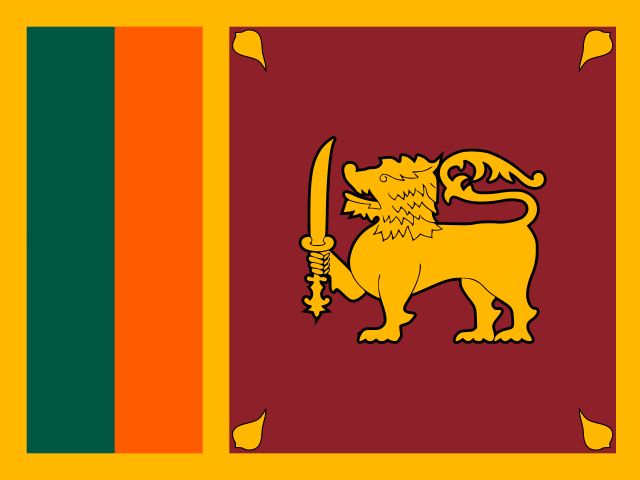
Sri Lanka
Sri Lanka’s primary energy supply mainly comes from oil and coal. Almost 40% of Sri Lanka’s electricity came from hydropower in 2017 but coal’s shares in power generation has been increasing since 2010. Sri Lanka is reaching universal access to electricity but clean cooking remain an issue with 15 million people still relying on biomass to cook.
- Overview
- Energy mix
- Emissions
- Electricity
-
+ 5 pages

![Sri Lanka Flag]()
-
Global Critical Minerals Outlook 2025 Policy mechanisms for diversified mineral supplies
Increasing cost pressures in operations outside dominant producers pose risks to diversification and sustainability efforts Supply chains for key energy minerals are highly concentrated, creating strong incentives for policymakers to build more secure and resilient supply chains through greater diversification. This concentration is often underpinned by network efforts, lower costs, and, in many cases, by relatively energy- and emissions-intensive processes. Capital expenditures for mining and refining in regions outside the dominant player are typically 50% higher than those within the top producing country. These producers also often face higher all-in sustaining costs, making it difficult to remain profitable…

-
Mali
In recent years, the rate of access to electricity in Mali has surpassed 25%, thanks to a public focus on mini-grid solutions. The government of Mali now plans to increase hybridisation of its mini-grids by adding PV capacity to diesel power plants. In 2019, Mali’s energy mix was dominated by biofuels and wastes (65%) and oil products (32%), with coal and hydro accounting for the rest. In 2020, less than 5% of the population had access to clean cooking and 52% had access to electricity. For electricity access, the country targets 70% access by 2025, 80% by…
- Overview
- Energy mix
- Emissions
- Electricity
-
+ 5 pages

![Mali Flag]()
-
Southeast Asia Energy Outlook 2024 Executive summary
Southeast Asia is a very dynamic region and a driving force behind global energy trends, with a projected rise in energy demand over the coming decades second only to India. It has accounted for 11% of global energy demand growth since 2010 but is projected to contribute more than 25% of the growth over the period to 2035 in the Stated Policies Scenario (STEPS), which indicates the direction of travel for the energy sector based on today’s policies. This increase in demand is underpinned by strong economic expansion, population growth, and Southeast Asia’s position as a global manufacturing…

-
Thailand
Thailand’s energy policy focuses on reducing dependence on natural gas to enhance energy security. With the costs reduction of variable renewable energy, conventional Thai power generation starts giving way to alternative sources. The country’s energy policy must evolve to accommodate this change.
- Overview
- Energy mix
- Emissions
- Electricity
-
+ 5 pages
![Thailand Flag]()
-
World Energy Employment 2025
The World Energy Employment (WEE) report series provides comprehensive tracking and analysis of the global energy workforce, including estimates of its size and distribution across regions, sectors, and technologies. It also assesses how energy labour requirements evolve to 2035 across all IEA scenarios.The WEE 2025 – the fourth edition – examines how skilled labour needs and shortages have changed since the series first highlighted these issues in 2022, and explores their implications for education and training systems, wages, policy, and the global buildout of energy infrastructure. This year’s report introduces, for the first time, detailed occupation-level estimates that offer…

-
Paraguay
Paraguay established renewable energy targets in its National Development Plan 2014–2030. The country’s goal is to reach 60% of renewable energy in total energy consumption by 2030. By the same year, Paraguay aims to reduce by 20% the share of fossil fuel within its total energy consumption.
- Overview
- Energy mix
- Emissions
- Electricity
-
+ 5 pages

![Paraguay Flag]()
-
Sheltering From Oil Shocks Cooking fuels
LPG demand accounts for around 10% of global oil demand and is used by many households for cooking. The conflict has caused major disruptions to LPG supply chains. With natural gas processing operations halted in parts of the region and flows through the Strait of Hormuz having come to a standstill, LPG supplies for cooking use have been severely curtailed, both locally and at export destinations. Next to measures to free up LPG capacity from other uses, such as in transport or industry, to prioritise domestic use, there are also actions to directly reduce cooking fuel demand. 9. Where possible…

-
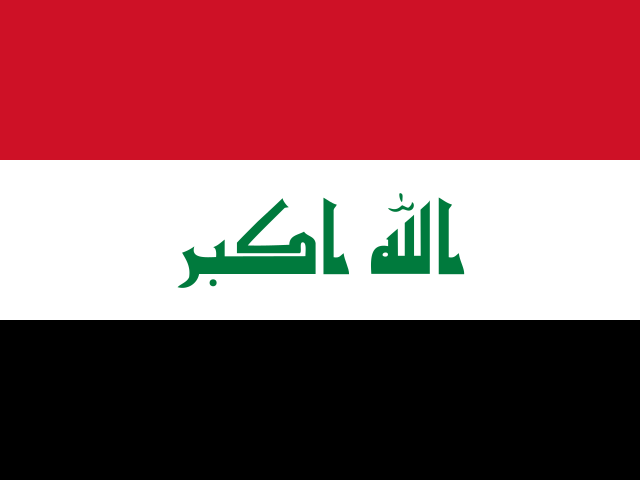
Iraq
Iraq holds abundant oil and gas resources and has strong solar PV potential. Its production to 2030 is set to be third largest contributor to global oil supply. By the same year, the government expects that renewable capacity will amount for 5% of the country’s total system capacity.
- Overview
- Energy mix
- Emissions
- Electricity
-
+ 5 pages

![Iraq Flag]()