-
Benjamin Gallezot
Interministerial Delegate for Strategic Minerals and Metals Supplies.

-
Renewables and Low-Emissions Fuels
Renewables and Low-Emissions Fuels

-
Energy Innovation
CERT co-ordinates and promotes the development, demonstration and deployment of clean energy technologies. The CERT has established five working parties: the Working Party on Fossil Energy; the Working Party on Renewable Energy Technologies; the Working Party on Energy End-Use Technologies; the Fusion Power Co-ordinating Committee and the Working Party of Industrial Decarbonisation. The CERT has also established an Experts' Group on R&D Priority-Setting and Evaluation (EGRD) to advise on R&D priority-setting, linkages to governmental policy objectives and methods in the evaluation of R&D activities, and an understanding of emerging R&D topics. Energy…
-
Mathilde Fajardy
Energy Analyst.

-
Christine Lagarde
President of the European Central Bank. She is a French politician and lawyer who has served as President of the European Central Bank since 2019. She previously served as the 11th Managing Director of the International Monetary Fund (IMF) from 2011 to 2019. Lagarde had also served in the Government of France, most prominently as Minister of the Economy, Finance and Industry from 2007 until 2011. She is the first woman to have hold each of those posts.

-
Henri Paillere
Head, Planning and Economic Studies Section at International Atomic Energy Agency (IAEA).

-
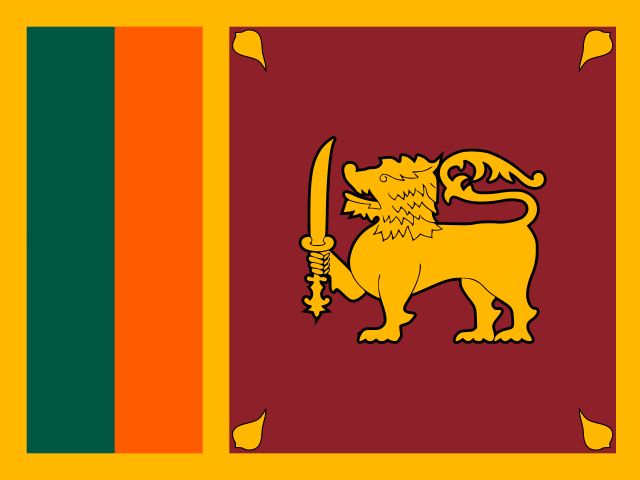
Sri Lanka
Sri Lanka’s primary energy supply mainly comes from oil and coal. Almost 40% of Sri Lanka’s electricity came from hydropower in 2017 but coal’s shares in power generation has been increasing since 2010. Sri Lanka is reaching universal access to electricity but clean cooking remain an issue with 15 million people still relying on biomass to cook.
- Overview
- Energy mix
- Emissions
- Electricity
-
+ 5 pages

![Sri Lanka Flag]()
-
Key Questions on Energy and AI
Following the publication of the IEA’s landmark Energy and AI report in 2025, this report examines how the energy and AI nexus has evolved amid surging investment in data centres and rapid advances in model capabilities. Drawing on fresh datasets and analysis, it explores where electricity demand is rising, how quickly grids and supply chains can respond, and what these shifts mean for energy security, affordability and sustainability.

-
Electrolysers
Country and regional highlights
Progress is spread across different continents, from China, which leads on installed capacity, to the European Union, which have adopted important policies, and other regions like India and the Middle East moving forward with a small number of large-scale projects
Technology deployment
Global installed electrolyser capacity reached 1.4 GW at the end of 2023, almost double the one at the end of 2022
Technology manufacturing
Innovation
Policy
Investment
Acknowledgements
-
Integrating Variable Renewable Energy in Kenya
Key challenges and strategic priorities Building on its renewable energy success, Kenya is now focused on managing a secure and reliable electricity system. With nearly 90% of the generation mix derived from renewable sources and electricity access rising from 37% in 2013 to 79% in 2025, the country has established itself as a regional leader in energy development.Integrating Variable Renewable Energy in Kenya explores how Kenya can strengthen its power system amid rising shares of variable renewable energy (VRE). The report identifies Kenya’s system to be operating in Phase 3 of the IEA’s VRE integration framework, where…