-
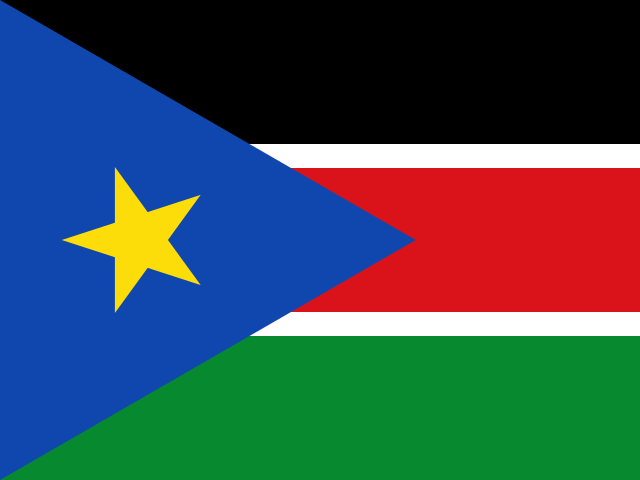
South Sudan
South Sudan is one of Eastern Africa's major oil resource holders but exported more than 85% of its production in 2014. Only 1% of the population had access to electricity in the country in 2017.
- Overview
- Energy mix
- Emissions
- Electricity
-
+ 5 pages

![South Sudan Flag]()
-
Blueprint for Action on Just and Inclusive Energy Transitions
Global Commission on People-Centred Clean Energy Transitions: Designing for Fairness June 2025 This year’s G20 President, South Africa, is placing a major focus on just and inclusive energy transitions. This builds on Brazil’s 2024 G20 Presidency which elevated just and inclusive energy transitions as a priority on the global agenda. Under Brazil’s Presidency, the G20 leaders endorsed ten voluntary Principles for Just and Inclusive Energy Transitions. The Global Commission believes these principles form a powerful framework for how governments, each navigating their own set of circumstances, can proceed with clean energy transitions that provide benefits and…

-
Energy System Resilience
Lessons learned from Ukraine Ensuring energy security encompasses both long-term and short-term dimensions. The long-term dimension involves securing sufficient infrastructure investment and diverse supply sources. The short-term dimension – resilience – focuses on systems’ ability to cope with events exceeding standard planning conditions. Since Russia’s full-scale invasion in 2022, Ukraine has worked to protect its energy sector and to increase its ability to withstand and rapidly recover from Russia’s attacks on its energy infrastructure. The report explores the lessons that Ukraine has been learning as it works to bolster system resilience and identifies measures that…

-
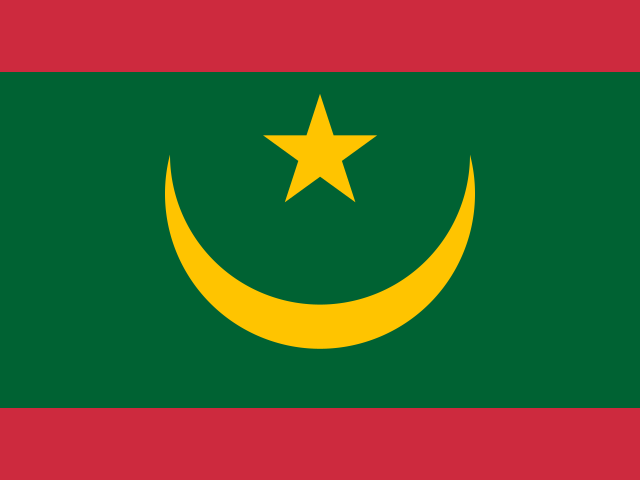
Mauritania
In 2019, Mauritania’s energy mix was dominated by oil products (65%) and biofuels and waste (32%). In 2020, 43% of the population had access to clean cooking which is the highest share in West Africa. In 2020, 47% of the population had access to electricity. For electricity access, the country targets universal access in urban areas and doubling of the current rate in rural areas by 2024, with country-wide universal access by 2030. For clean cooking, the target is 100% access to LPG in urban areas and 50% access to LPG in rural areas by 2030.
- Overview
- Energy mix
- Emissions
- Electricity
-
+ 5 pages
![Mauritania Flag]()
-
Bioenergy
Led by bioenergy, renewable fuels could approach 6% of energy demand from industry, buildings and transport in 2030
By 2030, renewable fuels are set to account for 5.5% of energy consumption from the industry, building and transport sectors. Demand is due to expand in all regions, but it is concentrated in China, Brazil, Europe, India and the United States, which collectively support more than two-thirds of the forecasted growth. All five countries and regions have dedicated support policies for several – and, in some cases, all – renewable fuels. These vary by fuel, sector and country, but they often include…
-
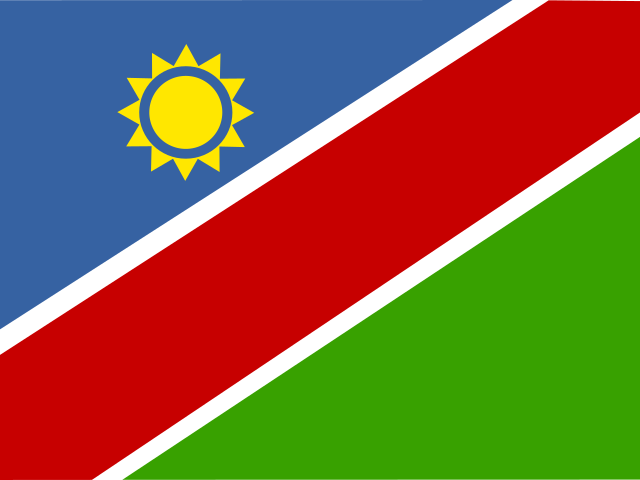
Namibia
Most of Namibia’s electricity is generated by hydropower. The country is also one of the ten-largest uranium resource-holders in the world and provides 8.2% of global production. The country has stated its interest in introducing nuclear power into its domestic mix.
- Overview
- Energy mix
- Emissions
- Electricity
-
+ 5 pages
![Namibia Flag]()
-
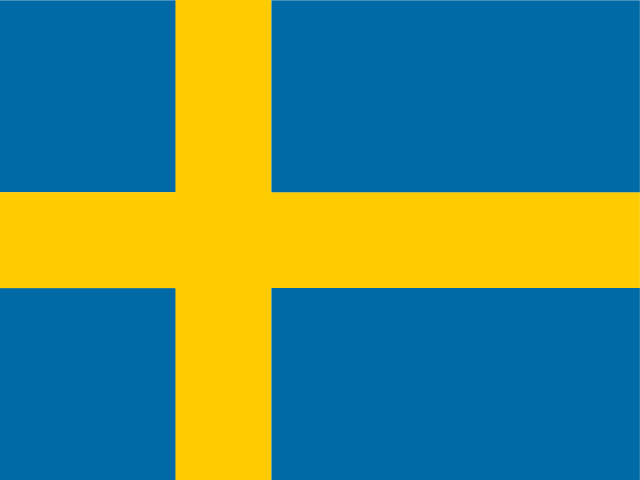
Sweden
Sweden is a global leader in decarbonisation and has targets to cut greenhouse gas emissions 59% by 2030 compared with 2005, and to have a net-zero carbon economy by 2045. Sweden was the first country to introduce carbon pricing and has the highest carbon price in the world, which has proven effective at driving decarbonisation. Most of Sweden’s electricity supply comes from hydro and nuclear, along with a growing contribution from wind. Heating is supplied mainly through bioenergy-based district heating and heat pumps.
Most of Sweden’s greenhouse gas emissions come from the transport sector, which remains…- Overview
- Energy mix
- Emissions
- Electricity
-
+ 5 pages

![Sweden Flag]()
-
Global Energy Review 2026
Global Energy Review 2026 This edition of the Global Energy Review provides the first full assessment of trends across the entire energy sector in 2025, with data for all fuels and technologies, all regions and major countries, and energy-related carbon dioxide (CO2) emissions.The report covers estimates of energy demand by region and by source and fuel in 2025; developments in electricity demand and supply; deployment of selected energy technologies; and estimates of energy-related CO2 emissions. The report also assesses trends in energy intensity and analyses the impact of factors, such as weather effects, on energy demand and…
- Key findings
- Global trends
- Oil
- Natural gas
-
+ 9 pages

-
Oil Market Report - June 2026
The IEA Oil Market Report (OMR) is one of the world's most authoritative and timely sources of data, forecasts and analysis on the global oil market – including detailed statistics and commentary on oil supply, demand, inventories, prices and refining activity, as well as oil trade for IEA and selected non-IEA countries. Highlights Global oil demand is forecast to decline by 1.1 mb/d y-o-y in 2026. This represents a downgrade of 700 kb/d compared with our May Report, as 2Q26 deliveries plunged by 5 mb/d y-o-y in the face of higher…

-
Chile 2050 Energy Transition Roadmap
World Energy Outlook Special report Chile has made significant strides in its energy transition, towards its ambitious long-term goals and it stands at a pivotal moment in its energy journey, possessing remarkable renewable and critical mineral resources. The Chile 2050 Energy Transition Roadmap, produced at the request of the Government of Chile, and in close collaboration with the Chilean Ministry of Energy, sets out a detailed pathway for the country to reach its legally binding goal of net zero emissions by 2050 while expanding economic growth and improving energy security and affordability. This pathway relies on four pillars: accelerating…