-
New Zealand
New Zealand has a diversified energy mix, with significant production of both hydropower and geothermal. As the country embarks on an ambitious energy transition, it has many natural advantages, including a strong renewable resource base. New Zealand already has a low-emissions electricity system, with over 80% of electricity coming from renewable sources. The key challenge will be to decarbonise other end-use sectors through clean power and support investments in new technologies to achieve deeper emissions cuts across all sectors. Notably, the transport sector accounts for the highest share of emissions and is almost entirely dependent on oil while…
- Overview
- Energy mix
- Emissions
- Electricity
-
+ 5 pages

![New Zealand Flag]()
-
Global EV Outlook 2025 Trends in other light-duty electric vehicles
Electric two- and three-wheelers Contrasting regional trends mean global sales of electric two- and three-wheelers remain at around 15% Two- and three-wheelers (2/3Ws) remained the most electrified road transport segment in 2024, with more than 9% of the global fleet now electric. The global sales share of electric models remained at around 15% in 2024 with total electric model sales reaching 10 million. The electric sales share stalled in 2024, mostly due to the shrinking Chinese electric 2/3W market, although growth in other regions was steady. China, India and Southeast Asia remain the world’s largest…

-
China’s Official Energy Finance in Emerging and Developing Economies Case 2. Southern power grid’s acquisition of Enel Peru distribution assets
Project overview and impact Latin America’s power systems face a growing need to modernise their electricity networks as clean energy deployment accelerates. While the region has seen a 25% increase in clean energy investment since 2015, grid spending has not kept pace, with less than USD 0.5 invested in networks and storage for every dollar spent on new generation. Strengthening distribution systems, especially in rapidly expanding urban areas, is essential to integrate more renewables. Peru is no exception. Although its electricity demand has grown steadily, network modernisation has lagged behind regional leaders, and the expansion of renewable capacity…

-
State of Energy Policy 2026
The IEA State of Energy Policy 2026 report provides with a unique review of policy progress made in 2025 across all energy sectors and instruments, with a special focus on government spending, energy efficiency regulations, and the contribution of the energy sector to nationally determined contributions and long-term net zero pledges.This year’s report brings an extensive examination of energy security policies to the period 1973-2025, from oil and natural gas to clean energy technology supply chains and critical minerals. It also spotlights the policy momentum around energy access, most particularly in sub-Saharan Africa, taking stock…

-
Cote D’Ivoire
Most of Cote d'Ivoire's primary energy demand is covered by local oil refinery supplies and domestic gas production. Almost 60% of the population had access to electricity in the country in 2017, a 10-percentage point’s increase from 2015.
- Overview
- Energy mix
- Emissions
- Electricity
-
+ 5 pages

![Cote D’Ivoire Flag]()
-
Denmark
Denmark has been an early leader in decarbonisation and in 2022 the government announced a net zero by 2045 target, aiming at 110% emissions reductions by 2050. Denmark’s technology leadership is important in the areas of offshore wind, biomethane and district heating. The government has expanded these categories to adopt a strategic focus on carbon capture and storage (CCUS) and hydrogen. The government has a robust energy and climate governance under the Danish Ministry of Climate, Energy and Utilities and ‘the year wheel’ of Climate Act of 2020 ensures annual policy actions and funding. Among IEA countries, Denmark has…
- Overview
- Energy mix
- Emissions
- Electricity
-
+ 5 pages

![Denmark Flag]()
-
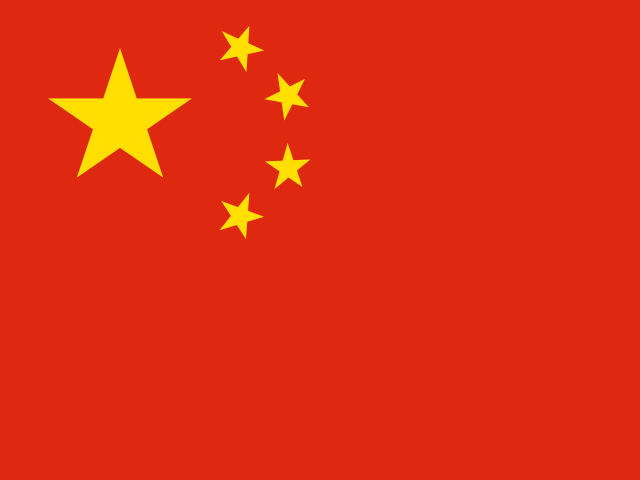
China
China’s growing energy needs are increasingly met by renewables, natural gas and electricity. The scale of China’s future electricity demand and the challenge of decarbonising the power supply help explain why global investment in electricity overtook that of oil and gas for the first time in 2016, and why electricity security is moving firmly up the policy agenda. That said, cost reductions for renewables are not sufficient on their own to secure efficient decarbonisation or reliable supply.
Between 2019 and 2024, China will account for 40% of global renewable capacity expansion, driven by improved system integration, lower curtailment…- Overview
- Energy mix
- Emissions
- Electricity
-
+ 5 pages
![China Flag]()
-
Latvia
Latvia is undertaking its energy transition with some promising results to date, with the goal to reduce total greenhouse gas emissions (without land use, land-use change and forestry) by 65% from 1990 levels by 2030 and to achieve net zero by 2050. It has made inroads on the share of renewable energy in its fuel mix, with sizeable shares of bioenergy and hydropower.
Renewable energy sources dominate its electricity mix, in particular, accounting for around three-quarters of domestic generation. Other sectors, notably transport and buildings, continue to consume large amounts of energy and rely on dated infrastructure that…- Overview
- Energy mix
- Emissions
- Electricity
-
+ 5 pages
![Latvia Flag]()
-
India Bioenergy Market Report
Outlook for liquid and gaseous biofuels to 2030 As demand for renewable energy grows in India, liquid and gaseous biofuels are expected to be one of the fastest-growing markets, driven by significant feedstock potential and supportive policies. These fuels can provide low-emission energy in heat, electricity and transport. They can also be produced domestically reducing reliance on imported fossil fuels, improve energy security, and create economic development and employment opportunities.This report examines the current supply and demand of liquid and gaseous biofuels in India and their forecasted growth to 2030. It provides a detailed assessment of existing…

-
Sustainable Transport Policy for Armenia: A Roadmap
As a part of the EU4Energy Programme, the Armenia Energy Policy Roadmap on Sustainable Transport presents a comprehensive, evidence-based framework for transforming the country’s mobility system into a sustainable and efficient transport system. The strategy seeks to deliver significant reductions in CO₂ emissions while strengthening regional connectivity, fostering economic development, and enhancing energy security. While Armenia has made notable progress in rolling out electric vehicles and electrifying its rail network, it still struggles with a high dependence on imported fossil fuels, a lack of data transparency and weak co-ordination among government agencies. This roadmap is structured to…