Cite report
IEA (2026), Global Hydrogen Review 2026, IEA, Paris https://www.iea.org/reports/global-hydrogen-review-2026, Licence: CC BY 4.0
Report options
Trade and infrastructure
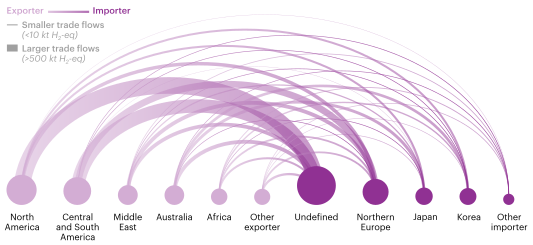
Trade remains a key driver of low-emissions hydrogen projects, and would underpin over 40% of announced volumes by 2030 if all projects materialise. Less than 8% of this, around 1 Mtpa H₂-eq (hydrogen equivalent), comes from projects that are operational, in construction, or have committed investments, compared with around 16% across the overall project pipeline.
First shipments of low-emissions hydrogen are taking place, enabling trials of logistics and certification approaches. Long-term bilateral contracts dominate, particularly for ammonia and ammonia-derived fertilisers, while hot briquetted iron (HBI) is gaining prominence.
Announced hydrogen pipeline projects, including new and repurposed natural gas pipelines, exceed 40 000 km by 2035, but only 9% of this length is operational or has a committed investment. Since GHR-25, operational and committed hydrogen pipeline length has increased by 70%. Activity remains concentrated in Europe and China, which saw major milestones in 2025, as China began construction of the world’s longest hydrogen pipeline, and Germany completed the world’s longest repurposing of a natural gas pipeline.
Announced underground hydrogen storage projects could provide 11 TWh of capacity by 2035 (335 kt H₂), but just over 7% has reached final investment decision (FID) or is under construction, equivalent to 0.6% of the estimated throughput from committed low-emissions hydrogen projects. Large-scale salt caverns are in construction in the United States, Germany and China.
Around 170 ammonia and 130 methanol port terminals are in operation. Ammonia leads among announced projects, but more methanol infrastructure is under construction, mainly linked to bunkering. In Japan, construction has started on the first commercial-scale terminal for liquefied hydrogen imports.
Pipelines are often the lowest-cost option for pure hydrogen transport where suitable routes are available and high utilisation rates can be achieved, while shipping can provide sourcing flexibility and use certain existing port infrastructure. However, where pure hydrogen is required at the point of use, shipping implies minimum costs of around USD 2/kg H₂ and energy use above 10 kWh/kg H₂, equivalent to over 30% of hydrogen’s energy content, due to intensive liquefaction or reconversion steps, such as ammonia cracking.
Bilateral trade flows of low-emissions hydrogen by carrier, excluding projects at earlier stages, 2030
Open