-
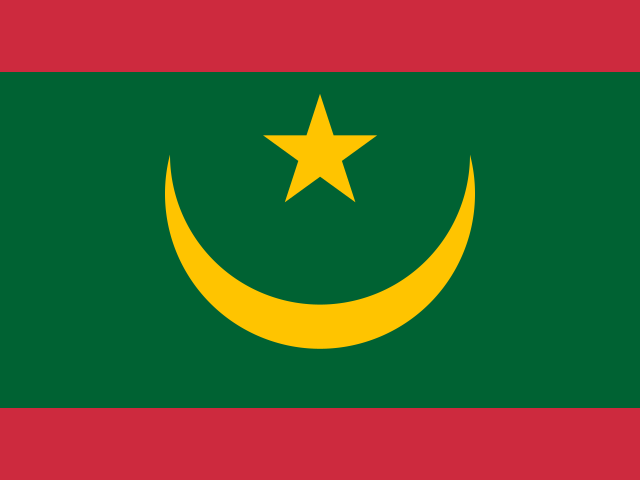
Mauritania
In 2019, Mauritania’s energy mix was dominated by oil products (65%) and biofuels and waste (32%). In 2020, 43% of the population had access to clean cooking which is the highest share in West Africa. In 2020, 47% of the population had access to electricity. For electricity access, the country targets universal access in urban areas and doubling of the current rate in rural areas by 2024, with country-wide universal access by 2030. For clean cooking, the target is 100% access to LPG in urban areas and 50% access to LPG in rural areas by 2030.
- Overview
- Energy mix
- Emissions
- Electricity
-
+ 5 pages

![Mauritania Flag]()
-
Ghana
In Ghana, electrification rates have gradually increased over the past 20 years, reaching almost 85% in 2017 and building on successful electrification plans. The country relies on a diversified energy mix and hosts the largest hydropower project of the Western African region.
- Overview
- Energy mix
- Emissions
- Electricity
-
+ 5 pages
![Ghana Flag]()
-
CLP Eco Building Fund
CLP provides subsidies for energy-saving improvement works in communal areas. From 1 October 2018 onwards, the scope of the Fund was extended to eligible commercial buildings, industrial buildings, and composite buildings and their nearby ancillary facilities. Under the CLP Eco Building Fund, residential, commercial, and industrial buildings can receive subsidies for energy-saving improvement works. The fund awards up to HK$100 million every year. The scope of the funding includes:-Retrofitting projects: Replace building services installations-Retro-commissioning projects: Optimise equipment and systems -Implementation of smart technology in building services installations-Industrial manufacturing installations
-
Act on Ensuring Security of Supply
It provides for mandatory energy-saving measures during peak demand periods, conducting campaigns to educate the public on the importance of energy conservation, provides incentives for consumers who reduce their energy consumption during critical times, restricting the use of non-essential services and equipment to lower overall energy demand, and collaborating with industrial sectors to optimize their energy usage and implement energy-efficient practices.
-
Voluntary Agreements in the Transport Sector
The objective is an energy saving of 9% in the operations of companies joining the energy efficiency agreements for goods transport and public transport in 2016 (2020). The public transport energy efficiency agreements aim at a minimum coverage of 80% of all companies or vehicles in the sector, and the goods transport agreements aim at 60% coverage.
-
Japan Team Minus 6% campaign
"Team Minus 6%" was a nation-wide energy-saving campaign initiated by the Japanese Ministry of Environment in 2005 to help reduce GHG emissions in line with the country’s Kyoto Protocol pledge. As members of the “team”, all Japanese citizens were encouraged to take six actions: limit their use of air conditioners, reduce water consumption, stop idling cars, buy environmentally friendly products, refuse extra wrapping of purchases and unplug unused appliances. By 30 June 2008, toward the end of the campaign, 2.3 million individuals and 22 000 companies had signed on. As part of the programme, the government…
-
12-month Amortisation Law Extension
The exceptional 12-month amortisation for energy saving materials under the 1999 Law of Finance was extended until 31 December 2002.
-
Minus 40 Per Cent Club for private households
92,000 households are being recruited for the Online Energy Saving Account (ESA) of the Minus 40 Per Cent Club. The software calculates the CO2 figures for the heating energy and electricity consumption figures read off and records how the minus 40% target (1990-2020) is achieved and exceeded. Participants are reducing their CO2 emissions by an average of 1.69% p.a. Interim results, examples and solutions to problems are communicated on an ongoing basis. An in-depth study is being carried out of a thousand households with internal energy production (photovoltaics, CHP) and another thousand with automated monitoring…
-
Subsidy scheme for building and maintenance of sporting accommodations
A subsidy scheme that since 2019 also includes energy measures (energy saving and renewable energy) for sports facilities, accommodation of sport clubs. Energy measures were upto 2018 included in a seperate scheme (EDS)
-
Performance Evaluation of Eco-friendly Home
…develop standards for the construction of energy-saving and eco-friendly housing and construct 2 million of such housings by 2020 in order to meet the challenges of climate change and achieve low-carbon green growth.
Owners of more than 30 apartment buildings or homes should submit a green home performance evaluation statement and related materials to the local government when applying for business approval. The local governments decide on the approval based on the review of energy agencies including the Korean Energy Agency.
Contents of the green home performance evaluation statement
Performance standards: Total energy consumption (CO2 emission) should…