-
Energy Saving Scheme : Solar Heaters Support
The Energy Saver Fund was a government-funded, residential energy efficiency grant programme administered by the Energy Efficiency and Conservation Authority (EECA). Funding was allocated by competitive tender to projects designed to achieve cost-effective improvements in residential energy efficiency, as well as the installation of solar water heaters. The fund also provided direct assistance grants in the form of reduced interest payments for the installation of solar water heaters for low-income family homes. These grants have had a significant impact on the solar water heating industry. EECA increased the size of the solar water heating programme, focusing on…
-
Energy Saving Action Plan
The Energy Saving Action Plan focuses on the penetration of renewables, energy efficiency improvements, energy efficiency labelling and education, information, and technology innovation. It is unclear to what extent the objectives of the Programme have been achieved. According to critics, in general performance has been poor, attributed to a lack of co-ordination among the institutions involved, limitations to the application of DSM by utilities, problems with enforcing building standards, a lack of awareness campaigns to accompany the introduction of labels, and a lack of substantial incentives for renewable energy.
-
Mexico
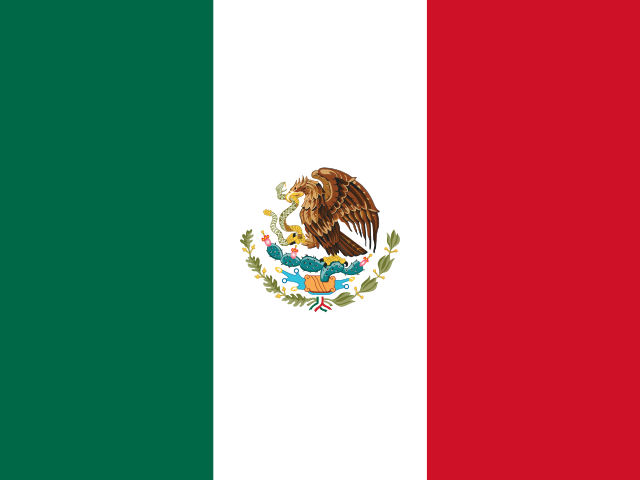
Mexico’s energy and economic profile presents both challenges and opportunities as a major oil producer, exporter and through its growing domestic energy demand. Mexico was the first large oil producing emerging economy to adopt climate legislation in 2012 and has seen growth in renewable electricity generation from wind and solar, which almost tripled from 2015 to 2022. However, strong action is needed across all sectors to reduce reliance on fossil fuels and bring down greenhouse gas emissions.
- Overview
- Energy mix
- Emissions
- Electricity
-
+ 5 pages

![Mexico Flag]()
-
Saving Energy at Home: Consultation and Appliance Replacement 2025 for Low-Income Households
Funding is provided for needs-based energy-saving consultations for private households affected by poverty, as well as for the replacement of inefficient large electrical appliances with energy-efficient ones. Access to the funding and eligibility verification are carried out at the social counseling centers
-
National Energy Saving Fund
Revolving fund for loans for energy saving measures in residential housing. Repayments are re-used in the funds. Banks and the government together provide the starting capital for the fund. The fund is also the result from actions in the Energy Agreement and Green Deals.
-
863 Energy-Saving and New Energy Vehicles Project
MOST invests RMB 1.1 billion, (US$174 million) setting technology roadmap for the EV industry
-
Unified Energy Saving Labeling Program
The 2005 revision of the Energy Conservation Act introduced new and reinforced labeling provisions for appliances. The new Uniform Energy Saving Label is mandatory for retailers and must contain information on the appliance's expected electricity cost or fuel usage information. The new comparative rating system is presented as five-star rating, and provides consumers with the information needed to compare across products in the same category. Efficiency increases with the number of stars.
As of October 2021, the label is required for nine designated products: air conditioners, electric refrigerators and freezers, electric toilet seats, TV sets, LED lights and… -
Voluntary energy saving agreement: electricity-intensive companies
…electricity-intensive companies can achieve relief of electricity tax (the PSO-tax) if a company enter a voluntary agreement scheme (VA). The key element in the VA-scheme is the agreement on energy efficiency. The agreement lasts for a period of maximum three years and can be extended.
The company maintains the VA by:
a. Undertake energy efficiency measures.
b. Maintain the energy management system.
c. Conduct special investigations
d. Report to DEA – a yearly report on the plan of action (including an update with new projects), the energy consumption (both electricity and other energy consumptions), progress on special investigations… -
Home Energy Saving Scheme (HESS)
Home Energy Saving Scheme (HESS) supported low-income households across Australia experiencing difficulty meeting and paying for their energy needs. HESS provided access to energy efficiency and financial management information and education, advice, advocacy, support, referral to the No Interest Loans Scheme if appropriate and integrated service coordination around energy efficiency and financial management. The Scheme was delivered through existing not-for-profit organisations providing general financial counselling services to individuals and focused on working with households to improve their financial and energy management practices and engagement with the energy market. In this way, it sought to build on and…
-
Home Energy Saving Scheme
…Sustainable Energy Ireland (SEI) began running the Home Energy Saving Scheme in March 2009. The grant scheme seeks to encourage retrofit investments by home owners to improve the energy efficiency of their homes. Fixed grants are available up to 40% of the cost. Eligible measures are insulation (cavity wall, attic, external wall, internal wall), heating controls, highly efficient boilers ( over 90% efficiency), and energy assessments. This scheme will be superseded by the National Retrofit Programme, which will be announced/properly launched later in 2011. This scheme was superseded by the launch of Better Energy: Homes under the Better Energy brand…