IEA
      • About
      • News
      • Events
      • Programmes
      • Help centre
      IEASkip navigation
          • Energy system Chevron down
            Explore the energy system by fuel, technology or sector
            Oil and natural gas supply

            Fossil Fuels

            Photo depicts a solar panels and windmills in the power plant

            Renewables and Low-Emissions Fuels

            Transport

            Transport

            Tracking industry

            Industry

            Tracking buildings

            Buildings

            Explore all
          • Topics Chevron down
            Understand the biggest energy challenges
            Iran tmo 2008052 lrg, NASA image courtesy Jeff Schmaltz, MODIS Rapid Response team

            The Middle East and Global Energy Markets

            Electricity security report cover

            Energy Security

            Photo Depicts Abstract Curly Tendrils Against Blue Background Gettyimages 1041976390

            Artificial Intelligence

            Critical Mineral Topic Page Header Image

            Critical Minerals

            Access and Affordability

            Pexels Googledeepmind 17485658

            Energy Innovation

            Investment Topic Page Cover Image Windwills In The Background With Solar Panels At The Foreground

            Investment

            Climate Change

            Thisisengineering X7cls0azgkg Unsplash

            Energy and Gender

            Russias War On Ukraine Topic Page Cover An Empty Train Station In Lviv Urkaine

            Russia's War on Ukraine

            • Investment
            • Climate Change
            • Energy and Gender
            • Russia's War on Ukraine
            • Energy and Water
            • Fossil Fuel Subsidies
            • Net Zero Emissions
            • Saving Energy
            • COP28: Tracking the Energy Outcomes
            All topics
          • Countries Chevron down
            Explore the energy system by country or region
            Member countries
            • Australia
            • Austria
            • Belgium
            • Canada
            • Czechia
            • Denmark
            • Estonia
            • Finland
            • France
            • Germany
            • Greece
            • Hungary
            • Ireland
            • Italy
            • Japan
            • Korea
            • Latvia
            • Lithuania
            • Luxembourg
            • Mexico
            • New Zealand
            • Norway
            • Poland
            • Portugal
            • Slovak Republic
            • Spain
            • Sweden
            • Switzerland
            • The Netherlands
            • Türkiye
            • United Kingdom
            • United States
            Accession countries
            • Brazil
            • Chile
            • Colombia
            • Costa Rica
            • Israel
            • Romania
            Association countries
            • Argentina
            • China
            • Egypt
            • India
            • Indonesia
            • Kenya
            • Morocco
            • Nigeria
            • Senegal
            • Singapore
            • South Africa
            • Thailand
            • Ukraine
            • Viet Nam
            All Countries and Regions
          • DataChevron down
            Use, download and buy global energy data

            Data explorers

            Understand and manipulate data with easy to use explorers and trackers

            Data explorers

            Data sets

            Free and paid data sets from across the energy system available for download

            Data sets

            Policies database

            Past, existing or planned government policies and measures

            Policies database

            Chart Library

            Access every chart published across all IEA reports and analysis

            Chart
            Explore data
          • Reports Chevron down
            Read the latest analysis from the IEA
            • Oil Market Report - June 2026

              Fuel report — 17 June 2026

              Oil Market Report - June
            • Sheltering From Oil Shocks

              Measures to reduce impacts on households and businesses

              Fuel report — 20 March 2026

              Photo depicts Aerial view of heavy traffic on a motorway in Perth, Australia, with a train running along the parallel railway line, several lanes congested with vehicles
            • GettyImages 2157213934

              World Energy Outlook 2025

              Read more

              Flagship report — 12 November 2025

            • The photo depicts a 3d rendered particle trail background. Magic sparkle trail effect. Shimmering waves with light effect isolated on black background. Lines swirl effect. Abstract motion.

              Energy Technology Perspectives 2026

              Read more

              Flagship report — 26 March 2026

            All reports
          • Search
          • Bag
            1
          • User Profile

          Sign In

          You are connecting via IP recognition from
          .

          If you wish to proceed, click on Connect.
          If you prefer to log into your personal account, please sign in below.

          ConnectConnect
          OR
          Error
          Eye
          Error
          Create an account

          Create a free IEA account to download our reports or subcribe to a paid service.

          Join for freeJoin for free
              All content Reports Data & Tools News & Events
              Authors Countries Energy system Newsletters Policies Programmes Sectors Topics
                • Country

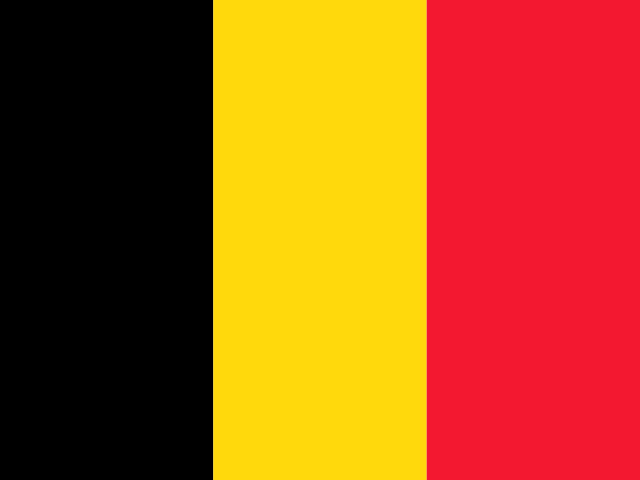
                Belgium

                Belgium’s energy policy is focused on transitioning to a low-carbon economy while ensuring energy security, lowering costs for consumers and increasing market competition. Belgium has made progress on these goals, notably as a global leader in offshore wind. The country is also seeing a rapid uptake of electric vehicles. However, Belgium remains reliant on fossil fuels and more aggressive policies are needed accelerate emissions reductions, especially for the industry sector.

                • OverviewOverview
                • Energy mixEnergy mix
                • EmissionsEmissions
                • ElectricityElectricity
                • + 5 pages

                Belgium Flag
                • Country

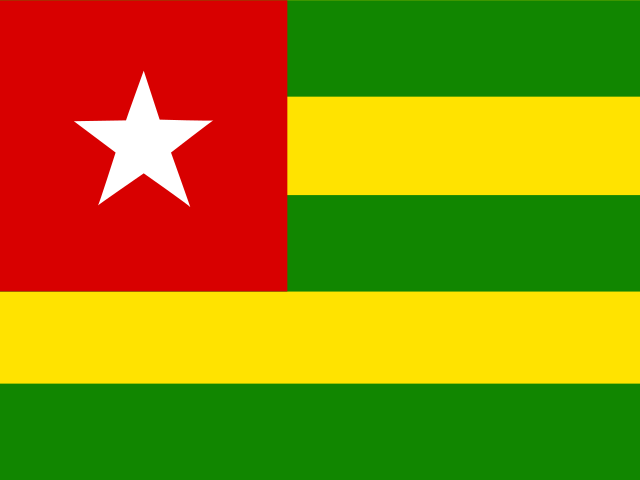
                Togo

                Less than half of the Togolese population has access to electricity. The country has a relatively diversified energy mix and more than 13% of its final energy consumption comes from renewable supplies of energy, mainly hydropower.

                • OverviewOverview
                • Energy mixEnergy mix
                • EmissionsEmissions
                • ElectricityElectricity
                • + 5 pages

                Togo Flag
                • Country

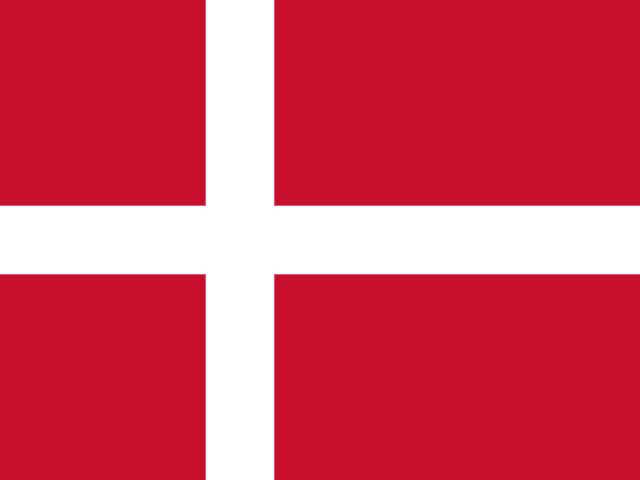
                Denmark

                Denmark has been an early leader in decarbonisation and in 2022 the government announced a net zero by 2045 target, aiming at 110% emissions reductions by 2050. Denmark’s technology leadership is important in the areas of offshore wind, biomethane and district heating. The government has expanded these categories to adopt a strategic focus on carbon capture and storage (CCUS) and hydrogen. The government has a robust energy and climate governance under the Danish Ministry of Climate, Energy and Utilities and ‘the year wheel’ of Climate Act of 2020 ensures annual policy actions and funding. Among IEA countries, Denmark has…

                • OverviewOverview
                • Energy mixEnergy mix
                • EmissionsEmissions
                • ElectricityElectricity
                • + 5 pages

                Denmark Flag
                • Country

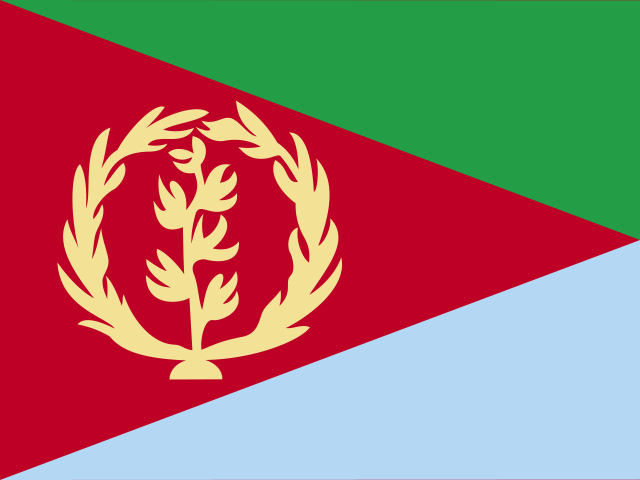
                Eritrea

                Less than half of the population of Eritrea has access to electricity. Most of the country's electricity generation comes from imported oil.

                • OverviewOverview
                • Energy mixEnergy mix
                • EmissionsEmissions
                • ElectricityElectricity
                • + 5 pages

                Eritrea Flag
                • Country

                New Zealand

                New Zealand has a diversified energy mix, with significant production of both hydropower and geothermal. As the country embarks on an ambitious energy transition, it has many natural advantages, including a strong renewable resource base. New Zealand already has a low-emissions electricity system, with over 80% of electricity coming from renewable sources. The key challenge will be to decarbonise other end-use sectors through clean power and support investments in new technologies to achieve deeper emissions cuts across all sectors. Notably, the transport sector accounts for the highest share of emissions and is almost entirely dependent on oil while…

                • OverviewOverview
                • Energy mixEnergy mix
                • EmissionsEmissions
                • ElectricityElectricity
                • + 5 pages

                New Zealand Flag
                • Country

                Mozambique

                In Mozambique, around 40% of people have access to electricity, through the grid or mini/off-grid systems. The government has promoted solar PV solutions in rural areas, reporting that 700 schools and 800 other public buildings now have electricity from solar.

                • OverviewOverview
                • Energy mixEnergy mix
                • EmissionsEmissions
                • ElectricityElectricity
                • + 5 pages

                Mozambique Flag
                • Country

                Canada

                Canada has set an ambitious target to cut greenhouse gas emissions by 40-45% from 2005 levels by 2030 and to reach net zero emissions by 2050. Canada’s energy and economic profile presents both challenges and opportunities to achieving these targets given its profile as a major producer, consumer and exporter of energy. Energy production and use in Canada accounts for over 80% of the country’s GHG emissions, with oil and gas production alone accounting for around a quarter. Canada’s electricity system is already among the cleanest in the world, with heavy dominance of hydropower as well…

                • OverviewOverview
                • Energy mixEnergy mix
                • EmissionsEmissions
                • ElectricityElectricity
                • + 5 pages

                Canada Flag
                • Country

                Japan

                Japan’s energy policy is guided by principles of energy security, economic efficiency, environmental sustainability and safety. Achieving the aim of carbon-neutrality by 2050 will require substantially accelerating the deployment of low-carbon technologies by 2030, to address regulatory and institutional barriers and further enhance competition in energy markets. It will also be important to develop different decarbonisation scenarios and to prepare for the possibility that certain low-carbon technologies, such as nuclear, might not expand as quickly as hoped. Stronger reliance on market-based instruments, such as carbon pricing, could be one policy option for Japan to cost…

                • OverviewOverview
                • Energy mixEnergy mix
                • EmissionsEmissions
                • ElectricityElectricity
                • + 5 pages

                Japan Flag
                • Country

                Bulgaria

                Bulgaria adopted The Energy from Renewable Sources Act in 2011. The Act regulates the generation and consumption of energy from renewable sources with the aim of achieving the national targets in terms of renewable energy use in final gross energy consumption.

                • OverviewOverview
                • Energy mixEnergy mix
                • EmissionsEmissions
                • ElectricityElectricity
                • + 5 pages

                Bulgaria Flag
                • Country

                Paraguay

                Paraguay established renewable energy targets in its National Development Plan 2014–2030. The country’s goal is to reach 60% of renewable energy in total energy consumption by 2030. By the same year, Paraguay aims to reduce by 20% the share of fossil fuel within its total energy consumption.

                • OverviewOverview
                • Energy mixEnergy mix
                • EmissionsEmissions
                • ElectricityElectricity
                • + 5 pages

                Paraguay Flag
              Previous page Prev
              Next Next page

              Newsletters

              The best of the IEA sent straight to your inbox

              Subscribe to newsletters

              Podcasts

              Top energy experts put IEA analysis in context

              Listen to our podcast
              • Understand energy
              • Reports
              • News and commentaries
              • Events
              • Energy system
              • Topics
              • Countries and regions
              • Glossary
              • Explore data
              • Data explorers
              • Data sets
              • Policies database
              • Chart library
              • Energy Statistics Browser
              • IEA essentials
              • About
              • Mission
              • Membership
              • Structure
              • Programmes
              • International collaborations
              • Technology collaboration
              • Training
              • Connect
              • Contact
              • Press
              • Careers
              • Internships
              • Delegates
              • Help centre
              IEA
              © 2026 IEA
              • Terms
              • Privacy
              • youtube
              • linkedin
              • bluesky
              • facebook
              • instagram
              • x (formally twitter)
              Back to top

              Subscription successful

              Thank you for subscribing. You can unsubscribe at any time by clicking the link at the bottom of any IEA newsletter.