Cite report
IEA (2025), The State of Energy Innovation 2025, IEA, Paris https://www.iea.org/reports/the-state-of-energy-innovation-2025, Licence: CC BY 4.0
Report options
Executive summary
Today’s energy technology landscape is highly dynamic. Innovations span a wide range of countries and technology areas, both emerging and established. These advances have implications for energy system planning and, ultimately, for the world economy. Whether incremental or disruptive, they are the products of government support, market expectations, finance, knowledge-sharing and accessible R&D and test facilities. It is testament to the efforts of energy innovators around the world that decision makers today can choose from a range of technology options to address strategic goals for all parts of the energy system. However, technological progress to tackle existing challenges and unlock new industrial opportunities relies on well-functioning innovation ecosystems and cannot be taken for granted.
This report provides a unique global review of progress and challenges in energy technology innovation. It follows the IEA’s first Energy Innovation Forum, which took place in 2024 alongside the IEA Ministerial. It is designed to inform the global energy innovation agenda at a time when energy innovation is increasingly at the core of countries’ competitiveness, security and resilience strategies, as well as those for addressing climate change. It is also a moment when uncertainties and emerging weaknesses could slow progress if not addressed. In addition to analysis of available data, the report draws on a dataset of over 150 energy innovation highlights from the past year, covering 45 countries and compiled with expert help from the IEA Technology Collaboration Programmes and a survey of almost 300 practitioners from around the world.
All phases of innovation, up to the early adoption of a new product in the marketplace, are covered in the report. After a new idea makes its way from the drawing board to a prototype and then out into the world, the pathway to maturity can be long, and success is not guaranteed. Even after products are first adopted, there is still a cost and performance gap with established technologies that policy attention must address. Across the innovation phases there are no simple metrics for measuring progress. However, many important insights into the health of the energy innovation system can be gleaned from data on R&D spending (a gauge of the effort directed to key challenges), patenting (a first-order indicator of R&D outputs), venture capital (VC) fundraising (a sign of the expected market value of new technologies), new product launches and competitiveness.
Spending on energy innovation has widespread pay-offs
Public and corporate energy R&D spending have risen in recent years, at around 6% per year in real terms. The latest available data indicate that direct government spending on energy R&D globally grew again in 2024, above the USD 50 billion of the previous year, but the rate of increase may have slowed. Initial indications of spending in 2024 in the United States and Canada suggest flatter year-on-year growth, balanced by larger increases in Japan and Norway.
Not every funded project will give rise to a radical new technology, but the impacts of this spending promise to be far-reaching. Estimates for the United States suggest that government R&D spending can generate economic returns to society over the following years that are thirty times higher than the costs. Average public energy R&D spending rose to an all-time high of 0.1% of GDP in the 1980s in IEA Member countries, in response to the energy security crises. Three-fifths of this went to nuclear, and from 1980 to 2000 nuclear power grew nearly fourfold in these countries, moderating demand increases for imported oil and gas. Today, these countries spend just over 0.04% of GDP on energy R&D, with nearly 60% in three areas – energy efficiency, nuclear and renewables.
IEA Member country public spending on energy R&D as a share of GDP, 1975-2023
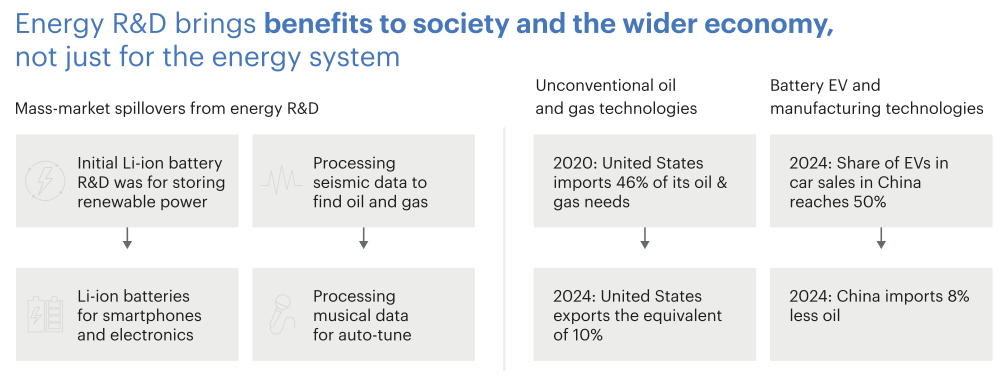
OpenThe impacts of energy technology innovation are also visible at the level of trade balances. The implementation of horizontal drilling and hydraulic fracturing enabled the United States to shift from importing 46% of its oil and natural gas needs in 2000 to exporting the equivalent of 10% of its demand today. Innovation in batteries, electric vehicles (EVs) and their manufacturing enabled China’s oil imports to be 8% lower in 2024 than if these EVs had been conventional cars. At around USD 200 billion per year, nearly 30% of the global value of technologies that became widely adopted only relatively recently – namely solar PV, wind, EVs and their batteries, electrolysers and heat pumps – is traded internationally.
Energy R&D can also bring societal benefits, for example by generating spillover benefits for other sectors. Initial research into rechargeable batteries to address renewable electricity variability led to the invention of lithium-ion batteries, which enabled smartphones. Once proven in portable devices, the technology was then adopted by the energy sector for EVs and electricity grids. Other technologies, such as those for appliance energy efficiency and payments for off-grid solar PV, have alleviated energy poverty and raised energy access.

The global landscape of energy innovation is changing
The United States, Japan and Europe led energy technology innovation for the past century, but today’s innovation landscape has shifted. China became the largest single country for energy patenting in 2021, overtaking Japan and the United States. More than 95% of China’s energy patenting in 2022, the latest year for which data are available, was in low-emissions technology areas. Globally, between 2000 and 2022, low-emissions energy patenting was four-and-a-half times that for fossil energy.
Energy patenting of the five countries with the most applications, 2015-2022
OpenToday, more innovation effort goes towards small-scale and modular energy technologies such as batteries and electrolysers, but there are international differences. Around half of China’s energy patenting and 90% of its venture capital (VC) is directed to mass-manufactured and modular low-emissions technologies, and innovation in these areas has helped underpin China’s lead in several energy technology supply chains. In Europe too, around 50% of energy patenting is for smaller-scale low-emissions technologies, but it is also active in large engineering projects that generally have more uncertain impacts on long-term competitiveness. Energy inventions from the United States are more equally spread across fossil fuel as well as large- and smaller-scale low-emissions technologies, and its large VC market has the capacity to place bets on all of them.
Ambitious policies have attracted private capital to energy innovation, but headwinds are mounting
Trends in VC show the importance of policy and markets for attracting capital to energy innovation. Fundraising by energy start-ups halved after the “cleantech bust” of 2011 to 2015, but turned around sharply between 2015 and 2022, rising 570%. Key to this switch were the higher expectations after the 2015 Paris Agreement for policy to underpin markets for low-emissions technologies, as well as low interest rates and cost declines for cornerstone products like solar PV and batteries. Even if only a small fraction of the 1 800 energy start-ups that raised VC funding in 2021-2022 meet their scale-up goals, the impact on energy by the 2030s promises to be very significant.
In total, since 2015, USD 230 billion has been injected into energy start-ups, and expectations for this market continue to grow. Investors and governments are increasingly harnessing the VC model for honing energy technologies via rapid prototyping, manufacturing and exposure to competition in the market. Our latest projections put the total value of this market for key low-emissions technologies at over USD 2 trillion 10 years from now under current policy settings. From 2010 to 2014, start-ups in China and Europe raised just 3% and 15% of global energy VC, respectively. In 2020 to 2024 their combined share rose to almost 50%, while the United States remained the single largest VC market.
Today’s more difficult conditions for VC funding raise cashflow concerns. In 2023 and 2024, annual energy-related VC funding declined by more than 20%. While VC funding has in general dropped due to inflation, the situation is compounded by uncertainties about political commitments to the climate policies that many start-ups depend on to drive demand. It is of special concern for firms with demonstration-scale or larger projects, which are costlier than prior stages.
Early- and growth-stage venture capital investment in energy start-ups, by technology area, 2010-2024
OpenAn exception to the overall VC downturn is artificial intelligence (AI), which doubled its fundraising in 2024. While this signals an opportunity to attract capital to the interface between energy and AI, it also raises the possibility that a wave of AI enthusiasm could draw funds away from energy innovators. Nevertheless, early-stage investment in energy storage and batteries also remains robust, and there were increases in funding in 2024 for start-ups working on technologies for nuclear, synthetic fuels and carbon capture, utilisation and storage (CCUS) among other areas.
Global venture capital investment by start-up sector, 2015-2024
OpenCorporate energy R&D spending has been growing three times faster than GDP, led by automotive companies, who now fill 13 spots in the list of the top 20 firms by energy R&D budgets. This growth highlights how innovation spending is triggered by regulation and competition. Spending has also been boosted by Chinese firms that have allocated increasing sums to R&D as their balance sheets have grown. Three Chinese state-owned energy companies now rank among the top ten largest corporate energy R&D spenders globally.
Races to demonstrate and scale up innovative energy technologies are taking shape
Addressing climate change will require significant advances in innovation. For example, around 35% of the emissions reductions needed to enable net-zero CO2 emissions globally still rely on technologies not yet demonstrated at commercial scale. Large-scale first-of-a-kind projects face a range of non-technical challenges related to finance, business models, public support, safety standards, infrastructure, tariff design and offtake contracts. Overcoming these hurdles will be key to unlocking major benefits – the market size for innovative, near-zero emissions materials, such as steel and cement, is set to exceed USD 25 billion by 2035 under current policy settings.
The IEA tracks 580 demonstration projects that are aiming to gather essential operational experience by 2030. Around USD 60 billion in public and private financing has already been allocated to these projects in areas such as hydrogen-based fuels production, advanced nuclear designs, floating offshore wind and CCUS. However, most have not yet reached a final investment decision, and inflation and policy uncertainty have caused delays. Funding is highly concentrated, with only 5% for projects outside North America, Europe and China, and skewed towards energy supply, with heavy industry and transport sector projects representing just 17% of the total funding for projects under construction.
Total funding for low-emissions energy demonstrations by sector and status, 2022-2035
OpenCorporate R&D in heavy industry and long-distance transport has not been rising as a share of revenues. The aviation and shipping sectors spent less on R&D in 2023 than in 2015. Cement and iron and steel companies increased their R&D spending as a share of revenue over the period, but far less than renewable energy equipment companies, which raised their R&D spending per unit of revenue by around 70% – to a level that is nearly three times higher than that of the cement sector. Yet heavy industry sectors require research and demonstration spending, calling for government support and international co-operation on major demonstration projects to share the costs within sectors.
We have identified 18 “Races to Firsts” demonstration challenges for important emerging energy technologies to track and encourage progress. These are key milestones that we believe to be mostly achievable within around 5 years with sustained policy support. They include a range of innovation across the entire sector, from the first building cooled with solid-state air conditioning, to the first repeatedly deployed small modular nuclear reactor, the first carbon-free flight and the first low-energy intensity ammonia production. They are all pertinent to a variety of different policy goals associated with the energy sector, and the IEA will track progress by the frontrunners as a means of recognising excellence and identifying areas for action.
The health of all parts of the innovation system determines the state of energy technology innovation
The recent innovation highlights presented in this report cut across all phases of the innovation process, from R&D to pilot, demonstration, fundraising and the launch of new products. In 2024, significant energy R&D advances included record-breaking efficiency for solid-state cooling that could avoid environmentally harmful refrigerants, if scale-up can be achieved. High-confinement plasma for nuclear fusion was maintained at steady-state for around 20 minutes for the first time by two different research groups. A prototype solid-state EV battery that could allow cars to be charged in nine minutes was reported, and trials were undertaken for higher-speed geothermal drilling through hard rock. Among larger-scale projects, first-of-a-kind progress was reported for perovskite PV manufacturing, ammonia use as a marine fuel, underground thermal and compressed CO2 long-duration energy storage, lithium recovery from geothermal brine, cellulosic bioethanol facilities and CCUS for cement production, among others. These projects are supported by countries including Australia, Brazil, China, Finland, Germany, Italy, Japan, Singapore and the United Kingdom.
A healthy innovation ecosystem generates progress in each phase for each technology area each year, and brings them to the market over time. The highlights, compiled by the IEA from stakeholder inputs, show that some technology areas – including battery technologies, CCUS, critical mineral sourcing, geothermal and solar PV – made significant recent advances across all main innovation phases.
Battery minerals, innovating with AI and carbon dioxide removal are in the spotlight for international co-operation
The diversity and resilience of battery mineral supplies can be improved with innovation in mining, recycling and battery chemistries. Cathodes with higher iron content and less nickel and cobalt, both of which have faced supply chain volatility, have rapidly taken a nearly 50% share of the global EV market. Continued support for solid-state and lithium-sulphur battery research is needed, alongside creation of markets for new sources of lithium and clarity on recycling standards.
Applying AI to accelerate energy innovation can reduce search times for new energy materials, including for cathodes, electrodes, CO2 capture, bioenergy and synthetic fuels. However, most successes are currently concentrated at the earliest innovation stages. To fulfil AI’s potential to reduce costs and democratise energy innovation, open access databases, reduced barriers to “self-driving labs”, and attention to scale-up are needed.1
Innovation in carbon dioxide (CO2) removal is being spurred on by private capital mobilised by carbon credits. By 2024, a total of 140 start-ups had been launched to pursue 13 different ways of removing CO2 from the atmosphere and preventing its re-emission. However, most of the USD 4.8 billion spent to date has been on just two approaches – direct air capture and bioenergy with CO2 capture and storage. To bring others to the market, more effort is needed on monitoring long-term performance and procurement of high-quality credits.
Number of known start-ups in the areas of battery mineral diversification, energy and artificial intelligence, and CO2 removal, 2015-2024
OpenTen areas for policy attention for the next year
Energy innovation policy is a dynamic area of government activity worldwide. Policy support is especially important in a sector marked by high barriers to entry such as capital intensity, long lead times, safety standards and the need for extensive physical infrastructure. These factors disadvantage new entrants – and necessitate policies that encourage experimentation via multi-year hardware-led projects. Encouragingly, we see creativity in policy design, including for debt products to address scale-up risks, prizes that quicken the learnings from grant-funded R&D, and open access testing. We also see opportunities to reinforce international co-operation as geopolitical factors and shifts in government priorities could otherwise squeeze near-term access to capital and limit how new ideas are exchanged internationally.
Consultations undertaken for this report revealed areas where more policy attention is sought, and these are combined in 10 priorities.
- Raise public energy R&D and demonstration spending to attract private sector co-funding, boosting competitiveness and growth.
- Ensure that the overall level of public and private support remains stable in priority areas through economic cycles, maintaining access to operating capital.
- Co-operate to bring a global portfolio of large-scale energy demonstration projects to fruition, especially for near-zero emissions steel and cement, aviation (including fuel production) and CO2 removal.
- Ensure that publicly funded research supports accessible training datasets so that energy innovators can grasp the full potential of AI-driven R&D.
- Support access to testing facilities and “living labs”, which can significantly shorten times to market for building energy management, geothermal, long-duration energy storage, heat networks and others.
- Work to reduce bureaucracy and align processes with innovators needs. Experiences with creative solutions – including permanently open calls, shared evaluations and multi-stage prizes – should be shared among governments.
- Tailor support to each technology’s innovation needs. In sectors such as building energy efficiency, the critical bottlenecks are largely non-technical.
- Strengthen energy innovation systems in emerging and developing economies. There is untapped potential for more effort within these countries, among countries facing similar challenges, and via international partnerships.
- Maximise innovation impacts from public investments in first-of-a-kind projects by sharing findings and policy experiences during project implementation.
- Foster markets that give confidence in robust future demand for the products of the most successful innovators. Government support can spur demand, competition and competitiveness.
References
A special IEA report on energy and AI will be published on 10 April 2025. It will cover the implications for energy innovation and many other applications of AI to optimise energy supply and use, as well as exploring datacentre electricity supplies.
Reference 1
A special IEA report on energy and AI will be published on 10 April 2025. It will cover the implications for energy innovation and many other applications of AI to optimise energy supply and use, as well as exploring datacentre electricity supplies.