IEA
      • About
      • News
      • Events
      • Programmes
      • Help centre
      IEASkip navigation
          • Energy system Chevron down
            Explore the energy system by fuel, technology or sector
            Oil and natural gas supply

            Fossil Fuels

            Photo depicts a solar panels and windmills in the power plant

            Renewables and Low-Emissions Fuels

            Transport

            Transport

            Tracking industry

            Industry

            Tracking buildings

            Buildings

            Explore all
          • Topics Chevron down
            Understand the biggest energy challenges
            Iran tmo 2008052 lrg, NASA image courtesy Jeff Schmaltz, MODIS Rapid Response team

            The Middle East and Global Energy Markets

            Electricity security report cover

            Energy Security

            Photo Depicts Abstract Curly Tendrils Against Blue Background Gettyimages 1041976390

            Artificial Intelligence

            Critical Mineral Topic Page Header Image

            Critical Minerals

            Access and Affordability

            Pexels Googledeepmind 17485658

            Energy Innovation

            Investment Topic Page Cover Image Windwills In The Background With Solar Panels At The Foreground

            Investment

            Climate Change

            Thisisengineering X7cls0azgkg Unsplash

            Energy and Gender

            Russias War On Ukraine Topic Page Cover An Empty Train Station In Lviv Urkaine

            Russia's War on Ukraine

            • Investment
            • Climate Change
            • Energy and Gender
            • Russia's War on Ukraine
            • Energy and Water
            • Fossil Fuel Subsidies
            • Net Zero Emissions
            • Saving Energy
            • COP28: Tracking the Energy Outcomes
            All topics
          • Countries Chevron down
            Explore the energy system by country or region
            Member countries
            • Australia
            • Austria
            • Belgium
            • Canada
            • Czechia
            • Denmark
            • Estonia
            • Finland
            • France
            • Germany
            • Greece
            • Hungary
            • Ireland
            • Italy
            • Japan
            • Korea
            • Latvia
            • Lithuania
            • Luxembourg
            • Mexico
            • New Zealand
            • Norway
            • Poland
            • Portugal
            • Slovak Republic
            • Spain
            • Sweden
            • Switzerland
            • The Netherlands
            • Türkiye
            • United Kingdom
            • United States
            Accession countries
            • Brazil
            • Chile
            • Colombia
            • Costa Rica
            • Israel
            • Romania
            Association countries
            • Argentina
            • China
            • Egypt
            • India
            • Indonesia
            • Kenya
            • Morocco
            • Nigeria
            • Senegal
            • Singapore
            • South Africa
            • Thailand
            • Ukraine
            • Viet Nam
            All Countries and Regions
          • DataChevron down
            Use, download and buy global energy data

            Data explorers

            Understand and manipulate data with easy to use explorers and trackers

            Data explorers

            Data sets

            Free and paid data sets from across the energy system available for download

            Data sets

            Policies database

            Past, existing or planned government policies and measures

            Policies database

            Chart Library

            Access every chart published across all IEA reports and analysis

            Chart
            Explore data
          • Reports Chevron down
            Read the latest analysis from the IEA
            • Oil Market Report - June 2026

              Fuel report — 17 June 2026

              Oil Market Report - June
            • Sheltering From Oil Shocks

              Measures to reduce impacts on households and businesses

              Fuel report — 20 March 2026

              Photo depicts Aerial view of heavy traffic on a motorway in Perth, Australia, with a train running along the parallel railway line, several lanes congested with vehicles
            • GettyImages 2157213934

              World Energy Outlook 2025

              Read more

              Flagship report — 12 November 2025

            • The photo depicts a 3d rendered particle trail background. Magic sparkle trail effect. Shimmering waves with light effect isolated on black background. Lines swirl effect. Abstract motion.

              Energy Technology Perspectives 2026

              Read more

              Flagship report — 26 March 2026

            All reports
          • Search
          • Bag
            1
          • User Profile

          Sign In

          You are connecting via IP recognition from
          .

          If you wish to proceed, click on Connect.
          If you prefer to log into your personal account, please sign in below.

          ConnectConnect
          OR
          Error
          Eye
          Error
          Create an account

          Create a free IEA account to download our reports or subcribe to a paid service.

          Join for freeJoin for free
              All content Reports Data & Tools News & Events
              Authors Countries Energy system Newsletters Policies Programmes Sectors Topics
                • Country

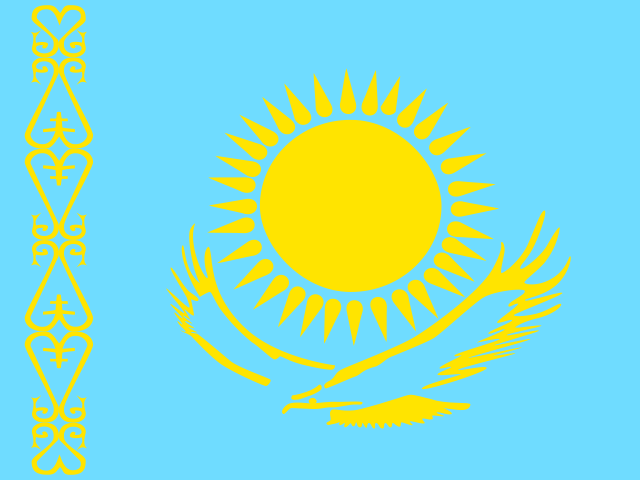
                Kazakhstan

                Kazakhstan is a significant producer of coal, crude oil and natural gas, and a major energy exporter. While coal dominates the country’s energy mix, renewable sources of energy are a small but growing share of Kazakhstan’s electricity generation. Gas pipeline network expansion remains a priority, in order to expand access and reduce reliance on coal and LPG for household consumption. Kazakhstan is part of the EU4Energy Programme, an initiative focused on evidence-based policymaking for the energy sector.

                • OverviewOverview
                • Energy mixEnergy mix
                • EmissionsEmissions
                • ElectricityElectricity
                • + 5 pages

                Kazakhstan Flag
                • Country

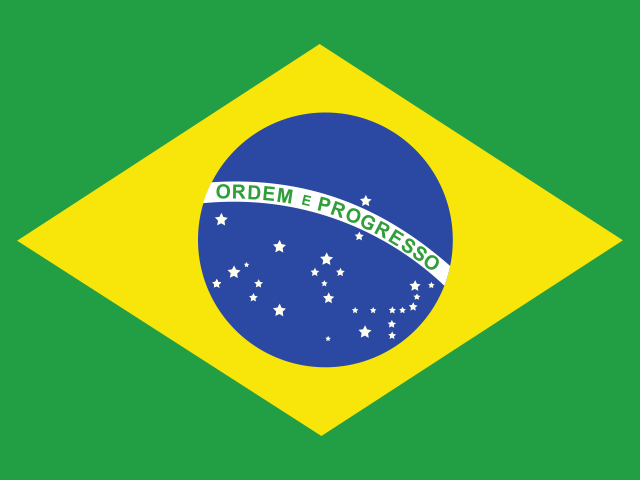
                Brazil

                …biofuels and flex-fuel cars provide a large domestic market. Ethanol supply is set to average 660 kb/d in 2026, up 90 kb/d compared with 2020 and 35 kb/d higher than in 2019. A system of contract auctions provides a mechanism to bring forward investment in new generation and transmission capacity, as well as to diversify the power mix.
                Large offshore oil and gas discoveries have confirmed Brazil’s status as one of the world’s foremost oil and gas provinces. Pre-salt discoveries also prompted a change in upstream regulation, granting Petrobras – the national oil company …

                • OverviewOverview
                • Energy mixEnergy mix
                • EmissionsEmissions
                • ElectricityElectricity
                • + 5 pages

                Brazil Flag
                • Country

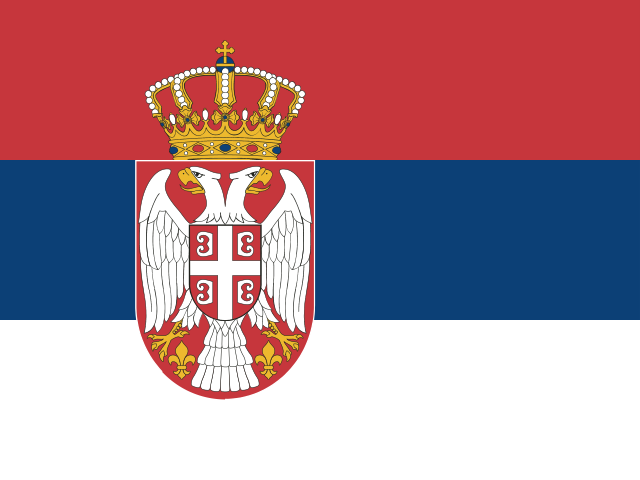
                Serbia

                In Serbia, the National Renewable Energy Action Plan set targets of renewable energy sources use until 2020, as well as the pathway to achieve them. Among other things, it enhances investments towards the development of renewables.
                Data for Serbia includes Montenegro until 2004.

                • OverviewOverview
                • Energy mixEnergy mix
                • EmissionsEmissions
                • ElectricityElectricity
                • + 5 pages

                Serbia Flag
                • Country

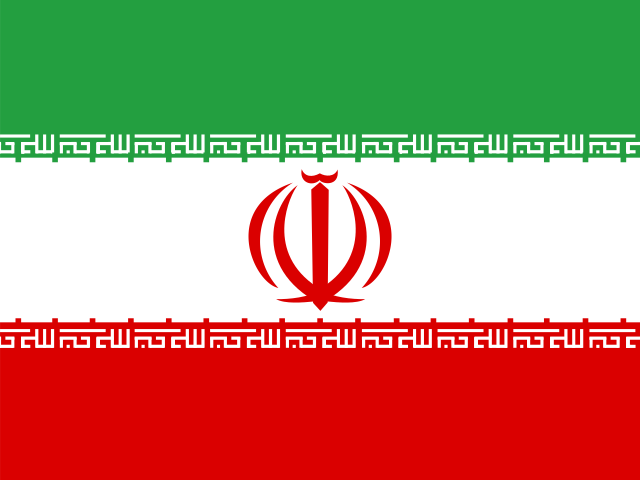
                Iran

                Iran has in place legislation obliging the Minister of Energy to increase the share of renewables and clean power plants to at least 5% of the country's capacity until the end of 2021.

                • OverviewOverview
                • Energy mixEnergy mix
                • EmissionsEmissions
                • ElectricityElectricity
                • + 5 pages

                Iran Flag
                • Country

                Libya

                In 2013, the Libyan government launched the Renewable Energy Strategic 2013-2025 Plan, which aims to achieve 7% renewable energy contribution to the electric energy mix by 2020 and 10% by 2025. This will come from wind, Concentrated Solar Power, solar PV and solar heat.

                • OverviewOverview
                • Energy mixEnergy mix
                • EmissionsEmissions
                • ElectricityElectricity
                • + 5 pages

                Libya Flag
                • Country

                Sweden

                Sweden is a global leader in decarbonisation and has targets to cut greenhouse gas emissions 59% by 2030 compared with 2005, and to have a net-zero carbon economy by 2045. Sweden was the first country to introduce carbon pricing and has the highest carbon price in the world, which has proven effective at driving decarbonisation. Most of Sweden’s electricity supply comes from hydro and nuclear, along with a growing contribution from wind. Heating is supplied mainly through bioenergy-based district heating and heat pumps.
                Most of Sweden’s greenhouse gas emissions come from the transport sector, which remains…

                • OverviewOverview
                • Energy mixEnergy mix
                • EmissionsEmissions
                • ElectricityElectricity
                • + 5 pages

                Sweden Flag
                • Country

                Georgia

                Georgia has developed an energy sector based largely on hydropower and fuelwood, in addition to imports of fossil fuels. It is also an important transit country for the region, with major oil and gas pipelines running across Georgian territory. Efforts are required to improve energy efficiency and capitalise on the country’s renewable energy potential.
                Georgia has made solid progress in the past decade, both in improving the security of its energy supply and in transitioning to a cleaner, more sustainable energy system. Although Georgia is still confronted with many challenges in its transition to a more secure, sustainable and…

                • OverviewOverview
                • Energy mixEnergy mix
                • EmissionsEmissions
                • ElectricityElectricity
                • + 5 pages

                Georgia Flag
                • Country

                Russia

                Russia is the world’s second-largest producer of natural gas, behind the United States, and has the world’s largest gas reserves. Russia is the world’s largest gas exporter. In 2021 the country produced 762 bcm of natural gas, and exported approximately 210 bcm via pipeline.

                • OverviewOverview
                • Energy mixEnergy mix
                • EmissionsEmissions
                • ElectricityElectricity
                • + 5 pages

                Russia Flag
                • Country

                Uzbekistan

                Despite being energy self-sufficient thanks to its gas sector, Uzbekistan's ageing infrastructure struggles to meet growing domestic demand. Losses, overuse and financing remain problematic. Wide-ranging reforms focused on improving and diversification the energy sector are being introduced and the government has adopted the Strategy of Actions 2017-2021, which prioritizes improving energy efficiency and increasing generating capacity and use of renewables. Uzbekistan is part of the EU4Energy Programme, an initiative focused on evidence-based policymaking for the energy sector.

                • OverviewOverview
                • Energy mixEnergy mix
                • EmissionsEmissions
                • ElectricityElectricity
                • + 5 pages

                Uzbekistan Flag
                • Country

                Cote D’Ivoire

                Most of Cote d'Ivoire's primary energy demand is covered by local oil refinery supplies and domestic gas production. Almost 60% of the population had access to electricity in the country in 2017, a 10-percentage point’s increase from 2015.

                • OverviewOverview
                • Energy mixEnergy mix
                • EmissionsEmissions
                • ElectricityElectricity
                • + 5 pages

                Cote D’Ivoire Flag
              Previous page Prev
              Next Next page

              Newsletters

              The best of the IEA sent straight to your inbox

              Subscribe to newsletters

              Podcasts

              Top energy experts put IEA analysis in context

              Listen to our podcast
              • Understand energy
              • Reports
              • News and commentaries
              • Events
              • Energy system
              • Topics
              • Countries and regions
              • Glossary
              • Explore data
              • Data explorers
              • Data sets
              • Policies database
              • Chart library
              • Energy Statistics Browser
              • IEA essentials
              • About
              • Mission
              • Membership
              • Structure
              • Programmes
              • International collaborations
              • Technology collaboration
              • Training
              • Connect
              • Contact
              • Press
              • Careers
              • Internships
              • Delegates
              • Help centre
              IEA
              © 2026 IEA
              • Terms
              • Privacy
              • youtube
              • linkedin
              • bluesky
              • facebook
              • instagram
              • x (formally twitter)
              Back to top

              Subscription successful

              Thank you for subscribing. You can unsubscribe at any time by clicking the link at the bottom of any IEA newsletter.